
‘Primary’ is everywhere in emails, reports, school papers, and everyday chat. If used too often, it becomes flat, and readers cease noticing it.
Writing stays sharp by mixing it up. It shows you put some thinking into your message instead of snatching the first term you find. It complements the tone, too. “Primary” may seem stiff in a text but sounds fine in a report. When you have options, you may say the same idea in a way that suits the room.
In this post, we’ll break down what “primary” truly means, when you should ditch it, and 25 good alternatives you can use immediately.
What Does “Primary” Really Mean?
“Primary” describes something that comes first in order, rank, or importance. It’s the thing everything else is measured against.
Say your manager asks, “What’s the primary reason the project is behind schedule?” She’s not asking for every reason. She wants the one that matters most, the root cause from which everything else stems.
That’s the core of the word: not just “important,” but “most important” or “first” in a specific lineup.
Why Look for Alternatives to “Primary”?
“Primary” is a fine word, but it flattens fast when repeated. A report that says “primary goal,” “primary concern,” and “primary factor” in three straight paragraphs reads like a checklist.
There’s a tone issue too. “Primary” leans formal and clinical. It suits business writing but can feel cold in a message to a friend. Sometimes you want something warmer, punchier, or less textbook.
Precision matters as well. “Primary” can mean “most important,” “first in time,” or “basic and foundational,” depending on context. A more specific word often says exactly what you mean without making the reader guess.
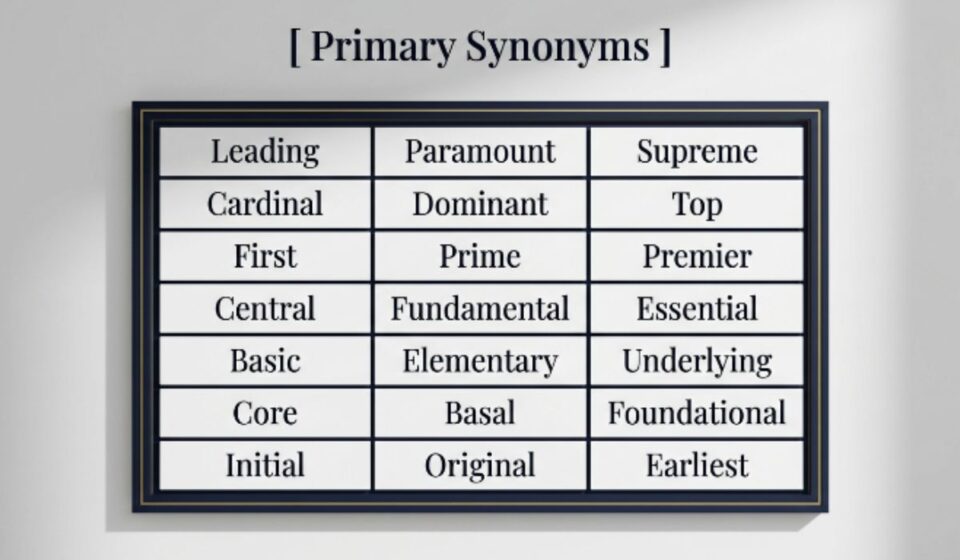
25 Synonyms for “Primary” and How to Use Them
Main
Meaning: The everyday stand-in for “primary.” It points to the biggest or most central part of something without sounding formal. It works almost anywhere because it’s so familiar, carrying no extra baggage or stiffness.
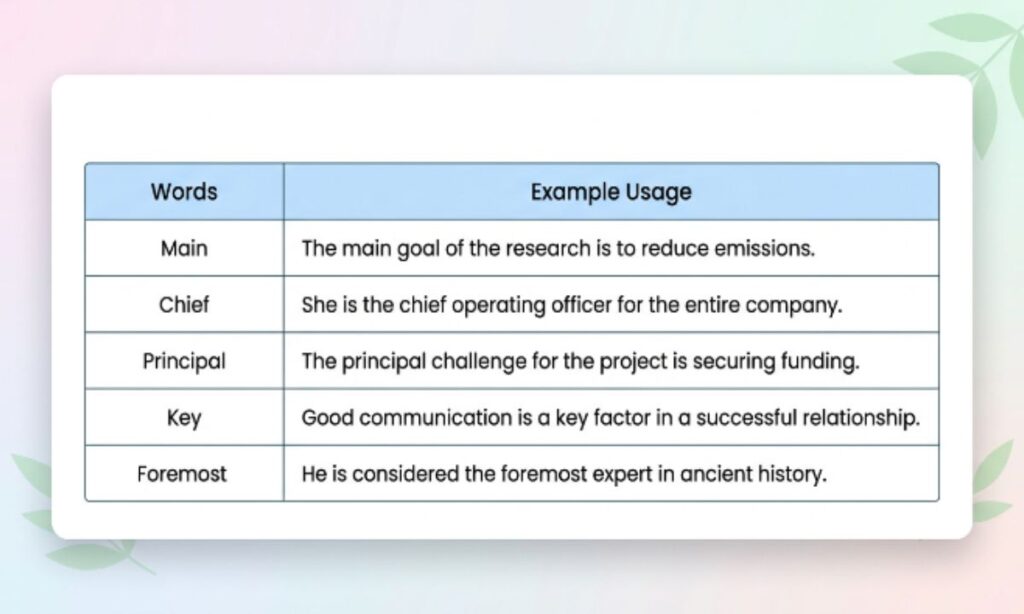
Example: The main reason she switched jobs was the long commute.
When It Fits: Casual conversations, quick emails, or anywhere you want a simple, natural word.
Chief
Meaning: Points to the top-ranking or most authoritative element in a group, often used with people or priorities. It carries a bit more formality than “main” without tipping into jargon, so it reads as measured rather than casual.
Example: Her chief responsibility is managing client relationships.
When It Fits: Workplace titles, formal writing, or describing someone’s top duty.
Principal
Meaning: Describes the most significant person, factor, or element among several options. It signals importance with a touch of formality, which is why legal, financial, and academic writing lean on it so heavily.
Example: The principal investor pulled out just before the deal closed.
When It Fits: Legal documents, finance discussions, or formal reports.
Foremost
Meaning: Ranks something as the top or leading item, especially in terms of reputation or skill. It adds respect and standing to whatever it describes, feeling more elevated than “main.”
Example: He is considered the foremost expert on marine biology in the region.
When It Fits: Introducing an expert, describing reputation, or writing bios.
Leading
Meaning: Refers to the top position in a race, market, or category, often tied to competition. It brings energy and motion to a sentence, suggesting progress rather than a static rank.
Example: The company remains the leading supplier of organic produce in the state.
When It Fits: Business writing, marketing copy, or competitive comparisons.
Key
Meaning: Marks something as essential or central to a plan, decision, or outcome. It feels modern and conversational, suggesting that without this one piece, everything else falls apart.
Example: Trust was the key factor in winning back the client.
When It Fits: Team meetings, presentations, or informal business writing.
Central
Meaning: Describes something at the core of a topic, plan, or argument. It has a spatial feel, as everything else revolves around it, which makes it useful for essays and strategy talks.
Example: Honesty is central to how she runs her team.
When It Fits: Essays, strategy talks, or describing themes and values.
Dominant
Meaning: Highlights something with more power, presence, or influence than everything around it. It carries a stronger, more assertive tone than most words here, suggesting real control, not just an edge.
Example: Fear was the dominant emotion in the room after the announcement.
When It Fits: Describing emotions, market position, or competitive advantage.
Paramount
Meaning: Describes something so important that nothing else comes close. It adds serious weight to a sentence, so it’s best saved for moments that truly deserve extra emphasis.
Example: Patient safety is paramount in every decision the hospital makes.
When It Fits: Healthcare, safety policies, or high-stakes announcements.
First
Meaning: Refers to something that comes before everything else, in time, order, or priority. It’s short, direct, and impossible to misread, which is its whole strength.
Example: Her first concern was whether the kids were safe.
When It Fits: Storytelling, instructions, or everyday speech.
Initial
Meaning: Points to the very start of a process, before anything develops further. It has a slightly technical feel, useful for separating an early stage from what comes later.
Example: The initial response from customers was mostly positive.
When It Fits: Project updates, feedback summaries, or planning stages.
Fundamental
Meaning: Describes something so basic that everything else depends on it. It points to a foundation rather than a priority, giving writing a thoughtful, almost philosophical tone.
Example: Clear communication is fundamental to any healthy relationship.
When It Fits: Discussing values, education, or foundational concepts.
Essential
Meaning: Marks something as necessary, something you can’t remove without breaking the whole. It carries warmth and urgency together, telling the reader that skipping this part isn’t an option.
Example: Sleep is essential for staying focused during exams.
When It Fits: Health advice, instructions, or persuasive writing.
Core
Meaning: Refers to the innermost, most fundamental part of a topic or plan. It has a grounded, physical feel and reads as modern without being flashy, which is why brands use it so often.
Example: Customer trust sits at the core of everything the brand does.
When It Fits: Branding, mission statements, or strategy documents.
Top
Meaning: Simply the highest-ranked or most significant item in a group. It’s the most casual option here, quick and punchy, and it doesn’t try to sound impressive.
Example: Her top priority right now is finishing the certification.
When It Fits: Texts, casual chats, or quick to-do lists.
Prime
Meaning: Describes something in its best or most important state, often tied to quality or timing. It suggests peak condition, not just rank, which gives it more color than plainer options.
Example: Spring is prime time for planting vegetables.
When It Fits: Describing timing, quality, or ideal conditions.
Cardinal
Meaning: Refers to something of the highest, most basic importance, often used with rules or principles. It has a formal, almost old-fashioned tone, signaling that breaking this rule is a serious matter.
Example: Never lying to a client is a cardinal rule at the firm.
When It Fits: Discussing rules, ethics, or non-negotiable principles.
Major
Meaning: Describes something large in scale or significance next to smaller, related items. It’s easy to use and instantly understood, a safe pick for both writing and speech.
Example: Losing the account was a major setback for the sales team.
When It Fits: Business updates, storytelling, or casual conversation.
Predominant
Meaning: Points to something that stands out more than the rest, often through frequency or influence. It has a slightly academic tone, useful when comparing patterns in a report.
Example: Blue was the predominant color in the artist’s early paintings.
When It Fits: Research writing, trend analysis, or descriptive summaries.
Foundational
Meaning: Describes something that acts as the base everything else is built on. It suggests structure and long-term stability rather than a temporary priority.
Example: Basic math skills are foundational for learning statistics later on.
When It Fits: Teaching, training programs, or skill development.
Elementary
Meaning: Refers to something basic or introductory, the starting point before things get complex. It carries a learning-focused tone, ideal for describing early lessons before deeper study.
Example: Understanding photosynthesis is elementary before studying plant biology in depth.
When It Fits: Education, tutorials, or explaining basics to beginners.
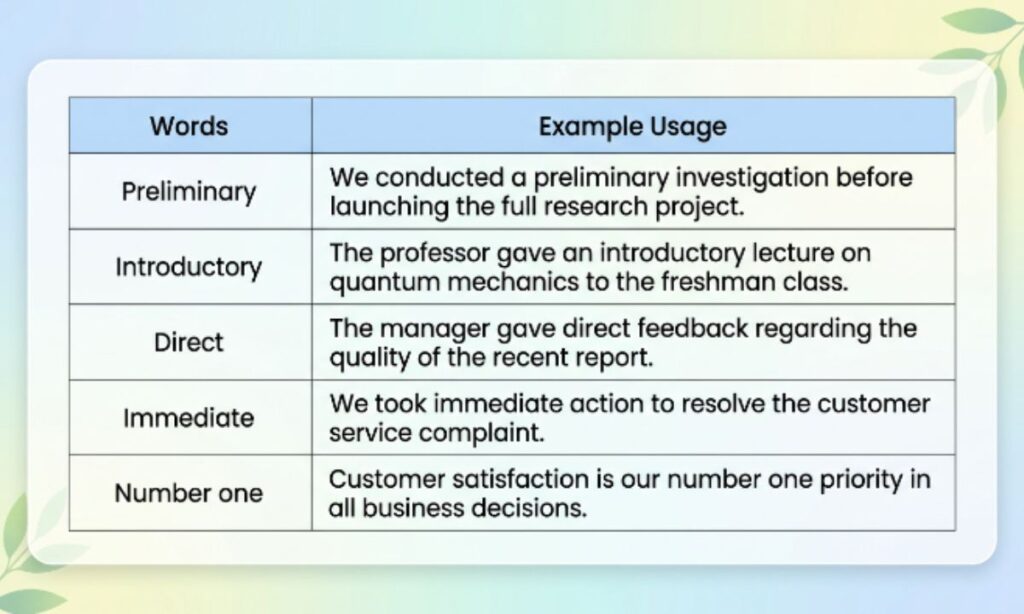
Direct
Meaning: Describes a cause or connection that happens without anything else getting in the way. It removes ambiguity and points straight at the source, useful for cause-and-effect writing.
Example: The delay had a direct impact on the shipping schedule.
When It Fits: Explaining cause and effect, reports, or troubleshooting.
Immediate
Meaning: Refers to something that matters right now, without any gap in time. It adds a sense of pressure and closeness, drawing the reader’s attention straight to urgency.
Example: Her immediate concern was finding shelter before the storm hit.
When It Fits: Emergencies, urgent requests, or time-sensitive updates.
Preliminary
Meaning: Describes an early step that happens before the main event or decision. It signals that something isn’t final yet, which suits research and professional writing well.
Example: The preliminary results looked promising, but the full study isn’t finished.
When It Fits: Research, planning stages, or early-stage announcements.
Original
Meaning: Refers to the very first version of something, before any changes were made. It carries a sense of history, useful when comparing something to later versions.
Example: The original plan called for a much smaller budget.
When It Fits: Comparing versions, storytelling, or historical context.
Which Alternative Should You Use?
The right word depends on where you’re writing and who’s reading it.
Work and formal reports: “principal,” “paramount,” “foundational,” or “predominant.” They sound polished and precise.
Emails: “main,” “key,” “essential,” and “top.” Clear without sounding stiff.
Friends and casual chats: “main,” “top,” “first,” or “major.” Natural, no effort to sound impressive.
School and academic writing: “fundamental,” “elementary,” “central,” and “predominant” carry the right tone for essays and research.
Everyday conversation: “key,” “main,” and “top” drop into speech without a second thought.
Common Mistakes
Using overly formal words in casual settings. Dropping “paramount” or “cardinal” into a text to a friend feels out of place.
Ignoring the specific meaning behind each word. “Direct” and “essential” aren’t interchangeable; one points to cause, the other to necessity.
Repeating the same synonym too often. Swapping “primary” for “main” and using “main” five times in a row just moves the repetition problem.
Mismatching word and sentence structure. “Foremost” usually fits better before a noun describing reputation, while “top” suits casual phrasing.
Forcing a synonym where “primary” was already the clearer choice. Sometimes the original word is genuinely the best fit.
Quick Comparison Table
| Phrase | Formal | Casual | Conversation | |
| Main | No | Yes | Yes | Yes |
| Chief | Yes | No | Yes | No |
| Principal | Yes | No | Yes | No |
| Foremost | Yes | No | Yes | No |
| Leading | Yes | No | Yes | Yes |
| Key | No | Yes | Yes | Yes |
| Central | Yes | No | Yes | No |
| Dominant | Yes | No | Yes | No |
| Paramount | Yes | No | Yes | No |
| First | No | Yes | Yes | Yes |
| Initial | Yes | No | Yes | No |
| Fundamental | Yes | No | Yes | No |
| Essential | Yes | Yes | Yes | Yes |
| Core | Yes | Yes | Yes | Yes |
| Top | No | Yes | Yes | Yes |
| Prime | No | Yes | Yes | Yes |
| Cardinal | Yes | No | Yes | No |
| Major | No | Yes | Yes | Yes |
| Predominant | Yes | No | Yes | No |
| Foundational | Yes | No | Yes | No |
| Elementary | Yes | No | Yes | No |
| Direct | Yes | Yes | Yes | Yes |
| Immediate | Yes | Yes | Yes | Yes |
| Preliminary | Yes | No | Yes | No |
| Original | No | Yes | Yes | Yes |
Frequently Asked Questions
Is “main” a good replacement for “primary” in professional writing?
Yes, “main” is simple and clear, though “principal” or “key” may sound more polished in formal reports.
What’s the difference between “primary” and “fundamental”?
“Primary” points to what matters most, while “fundamental” points to what everything else is built on.
Can I use “chief” to describe a person’s job title?
Yes, “chief” works well for describing someone’s top role or main area of responsibility.
Which synonym works best in a casual text message?
“Main,” “top,” or “first” all sound natural and relaxed in everyday texting.
Is it okay to use “paramount” in everyday speech?
It’s better saved for serious or formal situations, since it can sound overly dramatic in casual conversation.
Conclusion
“Primary” is a useful word, but it’s not the only one that gets the job done. With 25 alternatives on hand, you can match your tone to the moment, whether that’s a formal report or a quick text. Pick the word that fits the sentence, not just the meaning.