
Nuance is one of those words that sounds smart every time you use it, until you use it five times in the same paragraph. Then it seems kind of like a placeholder, rather than a real observation.
Language is most effective when it suits the occasion. A wine review, a legal memo and a text to a friend all need different words, even if the basic idea (a small but meaningful difference) is the same. When you have a toolbox of options, you can choose the tone that fits your audience, instead of falling back on the same safe word each time.
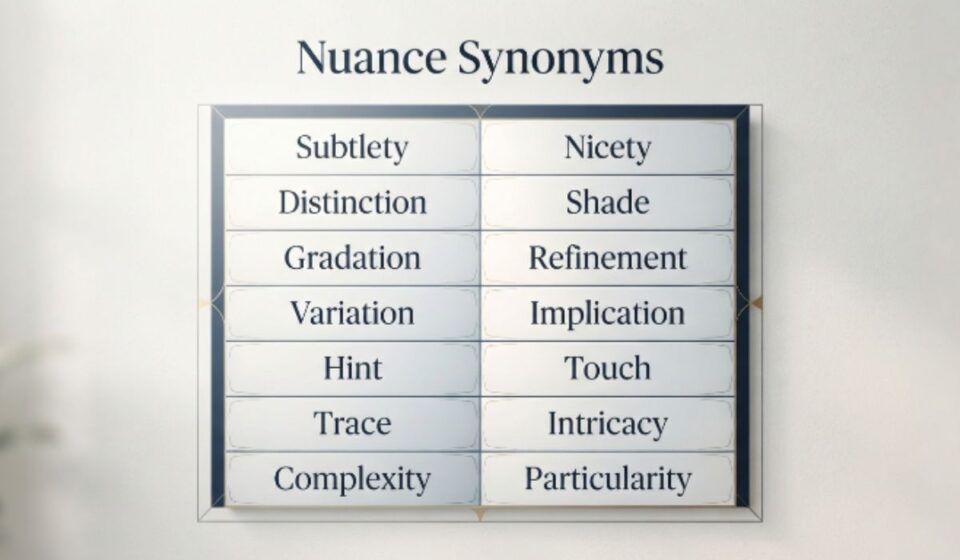
This piece explains the true meaning of “nuance,” when it starts to feel repetitive, and 25 alternatives you can pull from based on the context.
What Does “Nuance” Really Mean?
A nuance is a small, subtle difference in meaning, tone, feeling, or quality, the kind of detail that is easy to miss but changes how something is understood. Not a huge, glaring difference. It is the fine print of communication.
A manager, for example, might say to an employee, “There’s a nuance in the way you phrased that feedback. It came off as blunt rather than direct.” The words weren’t wrong exactly, but the tone changed how they landed. That subtlety is the little shift.
Why Look for Alternatives?
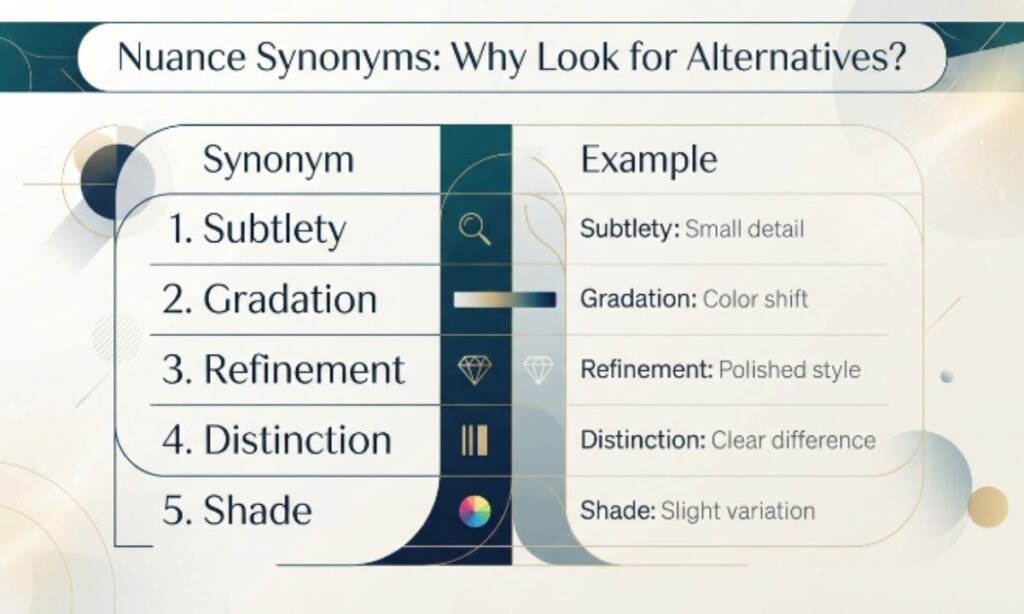
“Nuance” gets used constantly in writing, reviews, analysis, and even casual conversation, which means it’s lost some of its punch. When every review, article, or opinion piece describes something as “nuanced,” the word stops telling the reader much of anything specific.
It can also feel vague. Saying something has “a nuance” doesn’t always explain what kind of difference you’re pointing to, whether it’s a difference in tone, color, meaning, or feeling. Choosing a more precise word often communicates your point faster and with less ambiguity.
25 Better “NUANCE” Synonyms
1. Subtlety
Meaning: A quality of being delicate or hard to notice at first glance. It usually points to something that requires attention or experience to catch.
Example: “The subtlety in her argument only became clear on a second read.”
When It Fits: Discussing writing, art, or arguments that reward close attention.
2. Distinction
Meaning: A clear but often fine difference between two things that might otherwise seem similar. It works well when comparing options or ideas.
Example: “There’s an important distinction between being confident and being arrogant.”
When It Fits: Explaining the difference between two related concepts.
3. Shade
Meaning: A slight variation, often used for tone, meaning, or color. It suggests a gradual shift rather than a sharp change.
Example: “Every translator brings a different shade of meaning to the same poem.”
When It Fits: Describing tone, mood, or color-based differences.
4. Hint
Meaning: A very small trace of something, often something you sense more than fully see. It implies subtlety without much detail.
Example: “There was a hint of sarcasm in his reply that email didn’t quite capture.”
When It Fits: Everyday conversation about tone or emotion.
5. Refinement
Meaning: A small improvement or adjustment that makes something more precise or polished. It often implies effort went into the details.
Example: “The second draft had a refinement in structure that made the whole piece flow better.”
When It Fits: Talking about edits, design changes, or skill development.
6. Gradation
Meaning: A gradual, step-by-step change from one state to another, often used for color, sound, or degree. It suggests a spectrum rather than a single point.
Example: “The gradation in his tone made it hard to tell exactly when he shifted from calm to frustrated.”
When It Fits: Describing gradual shifts in color, mood, or intensity.
7. Nicety
Meaning: A fine or precise point, often one that matters a great deal to specialists but might be missed by others. It can also refer to small points of etiquette.
Example: “The lawyers spent an hour debating a nicety in the contract’s wording.”
When It Fits: Technical, legal, or academic discussions.
8. Touch
Meaning: A small, almost casual amount of a quality added to something. It’s a light way to describe a minor detail.
Example: “The dish needed just a touch more seasoning to bring out the flavor.”
When It Fits: Everyday descriptions of food, style, or design.
9. Trace
Meaning: A very faint amount of something, barely detectable. It often implies you had to look closely to notice it at all.
Example: “I could hear a trace of doubt in her voice, even though she agreed.”
When It Fits: Describing something faint in emotion, flavor, or scent.
10. Finesse
Meaning: Skillful, careful handling of a delicate situation or detail. It implies both subtlety and skill working together.
Example: “It took real finesse to deliver that criticism without hurting anyone’s feelings.”
When It Fits: Talking about how someone handles a tricky conversation or task.
11. Delicacy
Meaning: The quality of requiring careful, sensitive handling because something is fragile or easily misunderstood. It often applies to emotional or social situations.
Example: “She raised the topic with a delicacy that kept the meeting from turning tense.”
When It Fits: Sensitive conversations, negotiations, or emotional topics.
12. Suggestion
Meaning: A slight indication of something without stating it outright. It leaves room for interpretation.
Example: “There was a suggestion of impatience in how quickly he answered.”
When It Fits: Describing implied meaning in speech or writing.
13. Tinge
Meaning: A small trace of a quality or feeling mixed into something else. It’s often used for emotion or color.
Example: “His congratulations came with a tinge of envy he couldn’t quite hide.”
When It Fits: Describing mixed emotions or subtle color changes.
14. Discernment
Meaning: The ability to notice fine differences that others might overlook. It refers to the skill of perceiving nuance, not the nuance itself.
Example: “It takes discernment to tell the difference between constructive criticism and quiet dismissal.”
When It Fits: Talking about judgment, taste, or careful analysis.
15. Modulation
Meaning: A controlled shift in tone, pitch, or intensity, often used in speech, music, or writing. It suggests deliberate variation rather than an accident.
Example: “The speaker’s modulation kept the audience engaged through a long presentation.”
When It Fits: Describing changes in voice, music, or writing style.
16. Implication
Meaning: Something suggested indirectly rather than stated directly. It often carries meaning beyond the literal words used.
Example: “The implication behind her question was clear, even though she never said it outright.”
When It Fits: Reading between the lines in conversations or messages.
17. Connotation
Meaning: The emotional or cultural association attached to a word, beyond its literal definition. It shapes how a word feels, not just what it means.
Example: “‘Cheap’ and ‘affordable’ have the same basic meaning, but very different connotations.”
When It Fits: Word choice discussions, writing, or translation.
18. Variation
Meaning: A small difference between similar things, often used when comparing versions or styles. It’s broader and less delicate-sounding than nuance.
Example: “Each region has its own variation on the traditional recipe.”
When It Fits: Comparing similar items, styles, or approaches.
19. Inflection
Meaning: A change in tone or pitch of voice that alters meaning or emotion. It’s specific to how something is spoken rather than written.
Example: “The inflection in her voice turned the statement into a question.”
When It Fits: Describing spoken tone or vocal delivery.
20. Undertone
Meaning: A hidden or underlying quality beneath the surface meaning of something. It often refers to emotion or intent that isn’t stated directly.
Example: “There was a tense undertone to the meeting, even though everyone stayed polite.”
When It Fits: Describing atmosphere or hidden emotion in a conversation.
21. Wrinkle
Meaning: A small, unexpected detail that complicates an otherwise simple situation. It’s often used casually to describe a minor complication.
Example: “The plan was solid, except for one wrinkle nobody had considered.”
When It Fits: Everyday conversation about plans, problems, or complications.
22. Twist
Meaning: An unexpected variation on something familiar, often adding complexity or surprise. It’s more dramatic-sounding than most words on this list.
Example: “She put her own twist on the classic recipe by adding fresh herbs.”
When It Fits: Describing creative changes or unexpected turns.
23. Complexity
Meaning: The quality of having many interrelated parts or layers, making something harder to fully summarize in one sentence. It points to depth rather than a single small detail.
Example: “The complexity of the negotiation meant no single factor decided the outcome.”
When It Fits: Discussing multi-layered issues or decisions.
24. Texture
Meaning: The overall feel or quality created by many small details working together. It’s often used figuratively to describe depth in writing, music, or experience.
Example: “The novel’s texture comes from all the small details the author includes.”
When It Fits: Describing depth or richness in creative work.
25. Sophistication
Meaning: A refined, developed quality that shows careful thought or advanced skill. It suggests nuance has been intentionally built into something.
Example: “The sophistication of the design lies in details most people won’t consciously notice.”
When It Fits: Talking about advanced skill, design, or thinking.
Which Alternative Should You Choose?
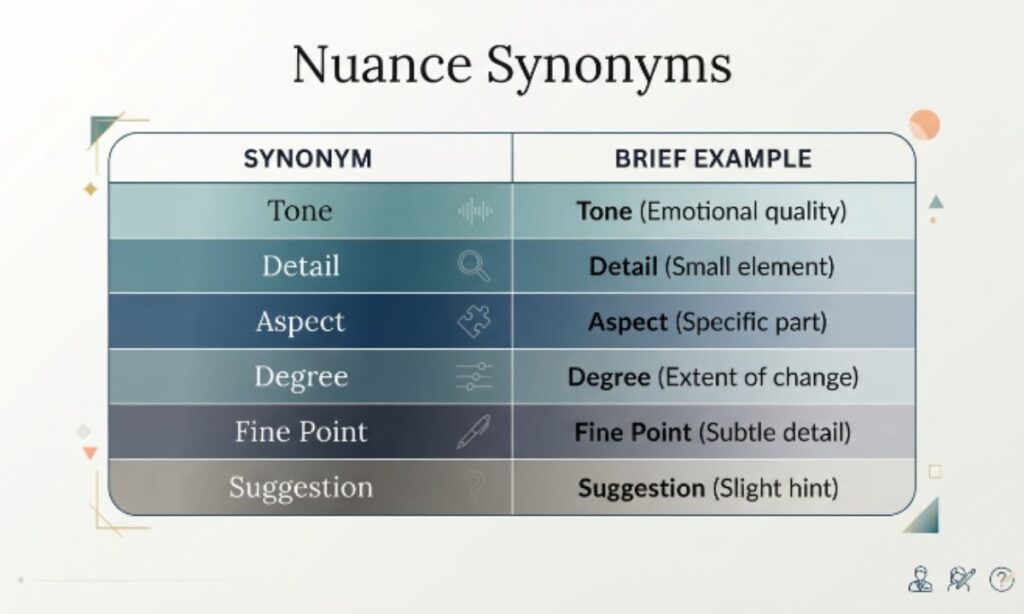
For work: “Distinction,” “refinement,” and “discernment” sound precise and professional without being overly casual.
For emails: “Nicety,” “implication,” and “variation” communicate clearly while staying appropriately formal.
For friends: “Hint,” “touch,” and “wrinkle” feel natural and easy in everyday conversation.
For school: “Connotation,” “gradation,” and “complexity” work well in essays and academic analysis.
For everyday conversation: “Undertone,” “tinge,” and “suggestion” are simple, relatable choices that don’t sound forced.
Common Mistakes
- Treating every synonym as interchangeable. “Shade” works for tone or color, but it sounds odd applied to a legal argument. Match the word to the type of difference you’re describing.
- Using heavier words in casual speech. Saying “there’s a sophistication to how you worded that” to a friend over text can sound stiff or overly formal.
- Forgetting that some words describe the skill, not the detail. “Discernment” refers to the ability to notice nuance, not the nuance itself. Mixing these up can confuse your sentence.
- Overloading a sentence with multiple synonyms. Using two or three of these words in one sentence can make writing feel cluttered instead of precise.
- Ignoring context clues like color, tone, or meaning. Words like “tinge” and “shade” work best with color or emotion, while “distinction” and “nicety” fit better with ideas and arguments.
Quick Comparison Table
| Phrase | Formal | Casual | Conversation | |
| Subtlety | Yes | Yes | Yes | Yes |
| Distinction | Yes | No | Yes | Yes |
| Shade | No | Yes | No | Yes |
| Hint | No | Yes | No | Yes |
| Refinement | Yes | No | Yes | Yes |
| Gradation | Yes | No | Yes | No |
| Nicety | Yes | No | Yes | No |
| Touch | No | Yes | No | Yes |
| Trace | No | Yes | No | Yes |
| Finesse | Yes | Yes | Yes | Yes |
| Delicacy | Yes | No | Yes | Yes |
| Suggestion | Yes | Yes | Yes | Yes |
| Tinge | No | Yes | No | Yes |
| Discernment | Yes | No | Yes | No |
| Modulation | Yes | No | Yes | No |
| Implication | Yes | Yes | Yes | Yes |
| Connotation | Yes | No | Yes | No |
| Variation | Yes | Yes | Yes | Yes |
| Inflection | Yes | No | Yes | No |
| Undertone | No | Yes | No | Yes |
| Wrinkle | No | Yes | No | Yes |
| Twist | No | Yes | No | Yes |
| Complexity | Yes | No | Yes | Yes |
| Texture | Yes | No | Yes | Yes |
| Sophistication | Yes | No | Yes | No |
Frequently Asked Questions
Is “nuance” a formal or casual word?
It leans slightly formal but is common enough in everyday speech to work in most conversations without sounding stiff.
What’s the best word for a nuance in tone of voice?
“Inflection” or “undertone” both describe subtle shifts in how something sounds, rather than what it means.
Can “distinction” and “nuance” be used interchangeably?
Mostly yes, though “distinction” often implies a clearer, more definable difference, while “nuance” suggests something more subtle.
Which word works best for describing color differences?
“Shade” and “tinge” are the most natural choices when talking about slight variations in color.
Is it okay to use “nuance” more than once in a piece of writing?
Yes, occasionally. The goal isn’t to avoid it entirely, just to prevent it from becoming the only word you reach for.
Conclusion
“Nuance” is a useful word, but it isn’t the only one that captures small, meaningful differences. Picking the right alternative, whether it’s “shade,” “distinction,” or “undertone”, helps your writing feel sharper and more specific. The right word does more work than a repeated, general one ever could.