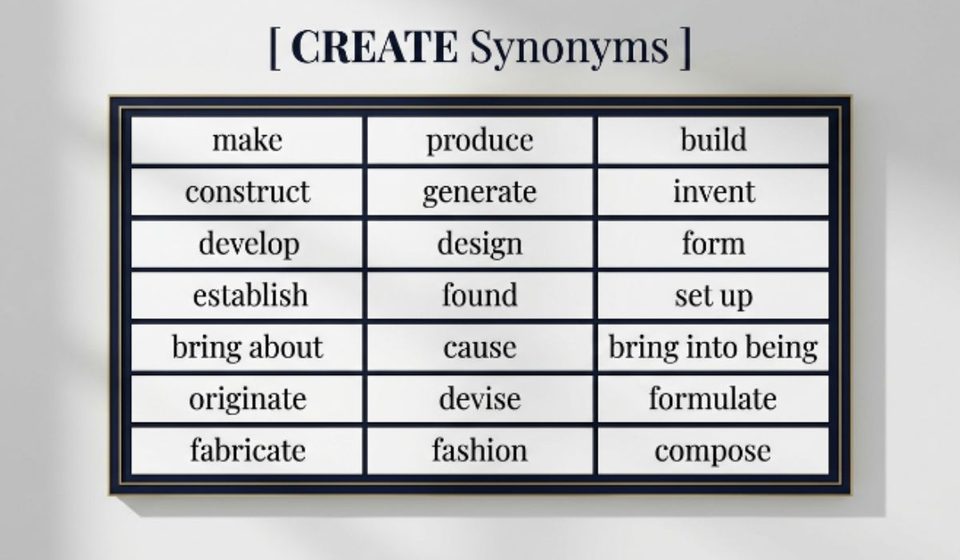

You’ve typed “create” for the fifth time in one paragraph, and it’s starting to look tired on the page. Your reader notices repetition even when they can’t name why something feels flat. The right synonym doesn’t just avoid repeats; it sharpens exactly what you mean. Here are 30 words that do the job better than “create” ever could.
What “Create” Really Means
At its core, “create” means to bring something into existence. But that one word is doing a lot of different jobs depending on context.
- Sometimes it means physically making something, like a sculpture or a meal.
- Sometimes it means causing a situation or feeling, like tension or excitement.
- Sometimes it means founding or setting up something formal, like a company or a scholarship.
- Sometimes it means dreaming something up mentally, before it exists anywhere else.
That’s exactly why one synonym rarely works everywhere. A word that fits a lab report sounds odd in a birthday card. This guide breaks 30 alternatives into the situations where each one actually earns its place.
How to Choose the Right Synonym
Before jumping into the list, it helps to know what you’re actually matching:
- The sense — are you making a physical thing, causing a situation, or founding something official?
- The register — does your writing call for formal, neutral, or casual tone?
- The domain — are you writing for business, tech, science, art, or everyday conversation?
Get those three right, and the word choice takes care of itself. Now let’s get into the alternatives.
Synonyms for Making and Producing
Make
Meaning: The simplest, most direct alternative to “create,” used when something is physically or practically brought into being. “Make” carries no extra weight or formality, which is exactly its strength. It works in casual speech and formal writing alike, and it rarely sounds forced. Readers process it instantly, without pausing to interpret tone.
- She decided to make a short film about her grandmother’s garden.
- The team worked overtime to make the product ready for launch.
When It Fits: Everyday writing, instructions, or conversation where simplicity beats sophistication.
Produce
Meaning: Suggests a process or system generating an output, often used in business, manufacturing, or creative work. “Produce” leans slightly more formal than “make” and implies effort, resources, or a repeatable process behind the result. It’s a strong fit when you want to highlight output rather than the act of making itself. This word also carries a faint sense of scale, as if more than one unit or instance is involved.
- The factory produces thousands of units every week.
- Her latest album was produced entirely from her home studio.
When It Fits: Business reports, manufacturing contexts, or describing creative output at scale.
Build
Meaning: Implies constructing something piece by piece, often over time, whether physical or conceptual. “Build” gives a sense of gradual assembly and effort, which makes it feel more deliberate than “make.” It works equally well for physical structures and abstract things like trust, reputation, or a career. Readers often associate it with durability, since something built is meant to last.
- They spent two years building the community center from the ground up.
- She’s building a reputation as a reliable freelance editor.
When It Fits: Describing long-term projects, relationships, or anything assembled step by step.
Construct
Meaning: A more formal and technical version of “build,” often used for physical structures or logical systems. “Construct” suggests precision and planning, which makes it feel more deliberate than “build.” It’s common in engineering, architecture, and academic writing where structure and method matter. Using it signals that the process behind the result was careful, not accidental.
- Engineers constructed a bridge capable of withstanding severe flooding.
- The professor asked students to construct a clear argument using evidence.
When It Fits: Technical writing, academic essays, or anything involving structured, methodical assembly.
Generate
Meaning: Suggests producing something continuously or automatically, often used for data, energy, ideas, or income. “Generate” fits especially well in technology and business contexts, where something is created as a byproduct of a process rather than a single deliberate act. It has a slightly mechanical feel, which makes it useful when you want to emphasize output volume. This word also works well for abstract things like interest, excitement, or revenue.
- The new pricing model helped generate steady monthly revenue.
- Solar panels generate enough power for the entire building.
When It Fits: Tech, business, and finance writing where output or byproduct is the focus.
Fabricate
Meaning: Refers to manufacturing something from raw materials, or, in a different sense, making up a false story. “Fabricate” carries two very different meanings depending on context, so clarity matters here. In manufacturing or engineering, it simply means to build or assemble from parts. In everyday speech, it often implies dishonesty, so use it carefully outside technical writing.
- The workshop fabricates custom metal parts for local machinery.
- He was accused of fabricating the entire story to avoid blame.
When It Fits: Manufacturing and engineering contexts, or describing dishonesty in a narrative sense.
Manufacture
Meaning: Specifically refers to producing goods on a large scale, typically using machinery or industrial processes. “Manufacture” is one of the most domain-specific words on this list, and it rarely fits outside industrial or business contexts. It signals repeatable, large-scale production rather than a one-off creative act. Using it outside that context can feel oddly stiff or misapplied.
- The company manufactures furniture using sustainably sourced wood.
- These components are manufactured in three different countries.
When It Fits: Industrial, manufacturing, and supply-chain writing specifically.
Synonyms for Inventing and Developing
Invent
Meaning: Implies originality, describing something that didn’t exist in that form before. “Invent” carries a sense of novelty and cleverness, making it a strong choice when originality is the point. It works for physical inventions, but also fits metaphorically for ideas, excuses, or explanations. This word tends to elevate the perceived creativity behind the result.
- The team invented a lighter, more efficient battery design.
- She invented a clever workaround for the scheduling conflict.
When It Fits: Highlighting originality, whether for physical products or clever problem-solving.
Develop
Meaning: Suggests a gradual process of improvement or growth toward a finished result. “Develop” works well when the emphasis is on the journey rather than a single moment of creation. It’s common in business, education, and product contexts, where something evolves through stages rather than appearing all at once. It also softens the tone slightly, implying care and iteration.
- The startup spent a year developing its flagship app.
- Teachers help students develop stronger critical thinking skills.
When It Fits: Describing gradual progress, product development, or skill-building over time.
Design
Meaning: Focuses on the planning and intentional structure behind something, rather than the raw act of making it. “Design” emphasizes thoughtfulness and purpose. It suggests that every element was chosen deliberately, which makes it a strong fit for anything involving aesthetics, usability, or strategy. This word tends to make the result sound more polished and intentional.
- The architect designed the house to maximize natural light.
- She designed a curriculum tailored to visual learners.
When It Fits: Architecture, product design, curriculum planning, or anything requiring intentional structure.
Devise
Meaning: Implies careful thinking to create a plan, method, or system, often to solve a specific problem. “Devise” leans formal and intellectual, suggesting effort and cleverness behind the result. It fits well when the created thing is a strategy, method, or solution rather than a physical object. Using it signals that thought, not just labor, went into the outcome.
- The committee devised a new voting system to reduce delays.
- He devised a simple trick to remember complex passwords.
When It Fits: Formal writing, strategy documents, or describing clever problem-solving.
Formulate
Meaning: Refers to carefully working out a plan, theory, or expression, often through precise and deliberate thinking. “Formulate” is common in academic, scientific, and strategic writing, where precision matters more than creativity. It suggests that the result was built from careful reasoning rather than spontaneous inspiration. This makes it a strong fit for anything that needs to sound rigorous.
- Researchers formulated a new hypothesis based on the latest data.
- The team formulated a clear response to the client’s concerns.
When It Fits: Academic, scientific, or strategic writing where precision matters.
Conceive
Meaning: Refers to forming an idea in the mind, often before any physical version of it exists. “Conceive” captures the mental origin of something, making it ideal for describing the earliest stage of an idea. It carries a slightly literary or reflective tone, which works well in storytelling or creative writing. This word also emphasizes imagination over execution.
- She conceived the idea for the novel during a long train ride.
- The plan was conceived years before it became reality.
When It Fits: Describing the mental origin of an idea, especially in reflective or creative writing.
Synonyms for Causing and Bringing About
Cause
Meaning: A direct, neutral word for making something happen, often used for effects, situations, or reactions. “Cause” is the most straightforward causation word on this list, and it works in nearly any context without sounding out of place. It doesn’t carry emotional weight on its own, which makes it useful when you want a plain statement of causality. Pairing it with a strong noun gives the sentence more impact than “create” would.
- The delay caused frustration among the entire team.
- Poor drainage caused flooding throughout the neighborhood.
When It Fits: Any writing where you need a plain, direct statement of cause and effect.
Bring About
Meaning: A phrasal alternative meaning to cause something to happen, often used for significant change. “Bring about” carries a slightly weightier tone than “cause,” often reserved for meaningful shifts rather than small, everyday effects. It works well in speeches, opinion pieces, and formal writing where the outcome matters on a larger scale. This phrase also reads naturally in both written and spoken English.
- The new policy brought about real change in workplace culture.
- Their persistence brought about a long-overdue apology.
When It Fits: Formal writing or speech describing meaningful, large-scale change.
Give Rise To
Meaning: Suggests that one thing leads naturally to another, often used for indirect or gradual effects. “Give rise to” works especially well when the connection between cause and effect isn’t immediate or obvious. It has a slightly literary tone, making it a good fit for essays, analysis, and formal explanations. This phrase also softens the causal link, implying a natural progression rather than a forced outcome.
- The budget cuts gave rise to widespread concern among staff.
- Early experiments gave rise to today’s more advanced techniques.
When It Fits: Analytical or explanatory writing where cause and effect unfold gradually.
Engender
Meaning: A formal word meaning to produce or give rise to a feeling, situation, or condition. “Engender” is one of the more elevated words on this list, often appearing in academic or literary writing. It works particularly well with emotions and abstract conditions, like trust, resentment, or loyalty. Because of its formality, it can feel out of place in casual or conversational writing.
- Consistent communication engenders trust between teams.
- The decision engendered resentment among longtime employees.
When It Fits: Formal, academic, or literary writing describing emotional or social effects.
Occasion
Meaning: Used as a verb, it means to cause or bring about something, often unexpectedly. “Occasion” is a less common choice, which makes it stand out when used correctly. It often implies that the cause wasn’t planned or deliberate, but happened as a byproduct of events. This word fits best in more formal or slightly old-fashioned writing styles.
- The sudden announcement occasioned confusion across the department.
- Her visit occasioned a small celebration among old friends.
When It Fits: Formal or slightly traditional writing, especially describing unplanned effects.
Prompt
Meaning: Suggests triggering an immediate reaction or response, often used for actions rather than physical objects. “Prompt” works well when something happens quickly, almost as a direct reaction to a stimulus. It’s common in journalism and everyday writing, especially when describing how one event leads to another in real time. This word feels energetic and immediate compared to slower causation words like “engender.”
- The complaint prompted an internal investigation.
- Her question prompted a long, thoughtful discussion.
When It Fits: News writing or everyday narration describing quick cause-and-effect moments.
Synonyms for Establishing and Founding
Establish
Meaning: Refers to setting something up on a firm, lasting basis, often an organization, rule, or relationship. “Establish” signals permanence and legitimacy, which makes it a natural fit for institutions, policies, and long-term arrangements. It’s commonly used in business and legal writing, where formality and structure matter. This word also works well for describing the founding moment of something meant to last.
- The founders established the company in a small rented office.
- New guidelines were established to improve workplace safety.
When It Fits: Business, legal, or institutional writing describing formal, lasting arrangements.
Found
Meaning: Specifically means to start an organization, institution, or movement, often as its original creator. “Found” is more specific than “establish,” usually reserved for the origin story of an organization or institution. It carries a sense of legacy, since the person who founds something is often remembered as its originator. This word rarely applies to physical objects or casual situations.
- She founded the nonprofit after volunteering abroad for years.
- The university was founded over a century ago.
When It Fits: Describing the origin of an organization, company, or institution specifically.
Set Up
Meaning: A casual, versatile phrase meaning to arrange or establish something, often quickly or practically. “Set up” feels far more conversational than “establish” or “found,” which makes it ideal for everyday writing and speech. It works for both small, practical tasks and greater organizational efforts, giving it unusual flexibility. This phrase rarely sounds forced, even in informal emails or messages.
- They set up a small stand at the local market.
- She set up a new filing system to keep the office organized.
When It Fits: Everyday, informal writing where a lighter tone suits the task at hand.
Institute
Meaning: Means to introduce or establish something formally, often a policy, rule, or system. “Institute” carries an official, procedural tone, making it a strong fit for policy and governance writing. It suggests that something is being introduced through a formal process, not spontaneously. This word pairs naturally with nouns like “policy,” “reform,” or “procedure.”
- The board instituted new rules for remote employees.
- Officials instituted stricter safety checks after the incident.
When It Fits: Policy, governance, or organizational writing describing formal new rules.
Informal and Everyday Alternatives
Dream Up
Meaning: An informal phrase meaning to imagine or invent something, often creatively or unexpectedly. “Dream up” has a playful, imaginative quality that “create” simply doesn’t carry. It works especially well when describing something unconventional, surprising, or slightly whimsical. This phrase feels natural in casual writing, marketing copy, or storytelling.
- Somehow the kids dreamed up an entire imaginary kingdom in the backyard.
- The marketing team dreamed up a campaign nobody saw coming.
When It Fits: Casual writing, marketing, or storytelling where a playful tone works.
Cook Up
Meaning: An informal phrase meaning to invent or plan something, often quickly or cleverly. “Cook up” carries a slightly mischievous or resourceful tone, suggesting the result came together fast and with a bit of ingenuity. It’s a great fit for casual conversation or lighthearted writing, but it would feel out of place in formal documents. This phrase also implies a bit of improvisation.
- They cooked up a plan to surprise her for the reunion.
- He cooked up an excuse on the spot.
When It Fits: Casual conversation or lighthearted writing describing quick, clever plans.
Come Up With
Meaning: A common phrase meaning to think of or produce an idea, plan, or solution. “Come up with” is one of the most natural-sounding phrases on this list, used constantly in everyday speech. It works well for brainstorming, problem-solving, and casual explanations of how an idea originated. Because it’s so common, it rarely draws attention to itself, which can be exactly what a sentence needs.
- She came up with a clever solution during the meeting.
- We need to come up with a better name for this product.
When It Fits: Everyday conversation, brainstorming sessions, or casual explanations.
Concoct
Meaning: Means to invent something, often a story, plan, or mixture, sometimes with a hint of cleverness or deceit. “Concoct” often implies a bit of cunning or improvisation, especially when used for stories or excuses. It’s also used literally for mixing ingredients, giving it a nice double life between food and storytelling. The word adds a slightly playful or suspicious edge that plainer synonyms lack.
- He concocted an elaborate excuse for missing the deadline.
- She concocted a new recipe using leftover vegetables.
When It Fits: Describing clever or slightly suspicious plans, or literal mixing and combining.
Domain-Specific Synonyms
Craft
Meaning: Suggests careful, skilled creation, often used for writing, messaging, or handmade work. “Craft” implies attention to detail and expertise, making it a favorite in marketing, writing, and design contexts. It elevates the perceived effort behind something, suggesting the result wasn’t rushed. This word works particularly well when the process itself deserves recognition.
- The copywriter crafted a message that resonated with new customers.
- She crafts each piece of jewelry by hand.
When It Fits: Marketing, writing, and design contexts where skill and care matter.
Compose
Meaning: Refers to putting parts together into a whole, especially used for music, writing, or formal documents. “Compose” carries an artistic, deliberate tone, often associated with music and literature. It suggests structure and intentional arrangement, rather than a quick or casual act. This word also works for formal writing, like composing an email or a report.
- She composed a symphony inspired by her hometown.
- He composed a carefully worded response to the complaint.
When It Fits: Music, literature, or formal written communication.
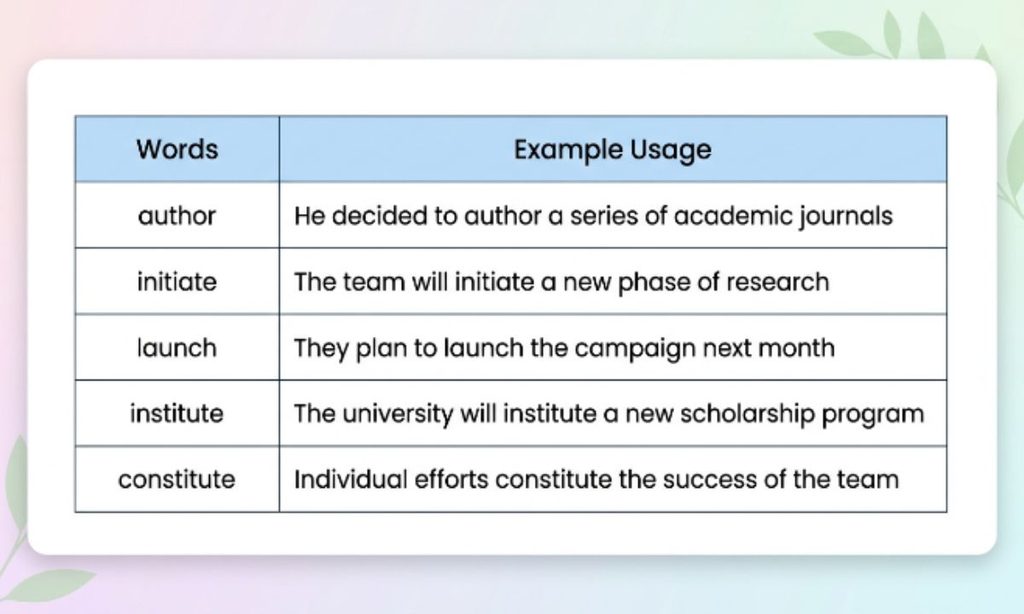
Author
Meaning: Used as a verb, it means to write or originate a piece of work, often a book, report, or document. “Author” places emphasis on ownership and responsibility for the finished work. It fits naturally in publishing, academic, and professional contexts where attribution matters. This word also works well when highlighting someone’s role as the originator of an idea or document.
- She authored three novels before turning thirty.
- He authored the initial proposal that shaped the entire project.
When It Fits: Publishing, academic, or professional writing where attribution is important.
Originate
Meaning: Means to bring something into being for the first time, often emphasizing where or how it began. “Originate” works best when the focus is on the source or starting point of something. It’s common in historical, scientific, and business writing, where tracing the beginning of an idea or trend matters. This word carries a slightly analytical tone compared to more casual synonyms.
- The tradition originated centuries ago in a small coastal town.
- The idea originated from a casual conversation between colleagues.
When It Fits: Historical, scientific, or analytical writing focused on origins.
Initiate
Meaning: Means to begin or start something, especially a formal process, project, or action. “Initiate” carries a procedural, business-like tone, making it a strong fit for corporate and technical writing. It suggests a deliberate first step rather than a spontaneous act. This word pairs well with formal nouns like “process,” “review,” or “protocol.”
- The company initiated a full review of its safety procedures.
- She initiated the conversation that eventually led to the merger.
When It Fits: Corporate, technical, or procedural writing describing formal starting points.
Launch
Meaning: Means to introduce something new to the public, often a product, service, or campaign. “Launch” carries energy and momentum, evoking the image of something taking off. It’s especially common in business and marketing writing, where the introduction of something new is a key moment. This word works less well for private or internal creations, since it implies public visibility.
- The company launched its new app to strong early reviews.
- They launched a campaign to raise awareness about local wildlife.
When It Fits: Business, marketing, or product writing describing a public introduction.
Spin Up
Meaning: A modern, informal tech phrase meaning to quickly set up or start something, often a system or process. “Spin up” is heavily associated with technology and startup culture, describing something created fast and often temporarily. It carries a casual, energetic tone that fits internal team communication or tech writing better than formal documents. This phrase signals speed and low friction.
- The engineering team spun up a test server within minutes.
- We can spin up a quick prototype before the client call.
When It Fits: Tech, startup, or internal team writing describing fast, temporary setups.
Antonyms and Near-Opposites of Create
Knowing the opposite of “create” helps sharpen contrast in your writing, especially when describing loss, removal, or undoing.
| Category | Examples |
| Physical destruction | destroy, demolish, annihilate, dismantle |
| Ending something formal | abolish, dissolve, disband, shut down |
| Preventing or blocking | suppress, stifle, prevent, restrain |
| General undoing | undo, reverse, eliminate, erase |
Choosing the right antonym follows the same logic as choosing a synonym: match the sense, register, and domain of your sentence.
Frequently Asked Questions
What is the best synonym for create in writing?
It depends on context, but “develop,” “produce,” and “craft” work well across most general writing.
What is a stronger word for create?
“Engender” and “originate” carry more weight and formality than plain “create.”
What is the opposite of create?
Common opposites include “destroy,” “demolish,” and “abolish,” depending on what’s being undone.
What is a good synonym for create in business writing?
“Establish,” “launch,” and “initiate” fit naturally in professional and corporate contexts.
How do I replace “create” in casual conversation?
Try “come up with,” “set up,” or “cook up” for a more natural, everyday tone.
Conclusion
Swapping out “create” isn’t about avoiding a perfectly good word altogether; it’s about matching your language to exactly what’s happening in the sentence. Whether you’re describing a factory line, a founding story, a clever excuse, or a quiet moment of inspiration, one of these 30 alternatives will say it more precisely than “create” ever could on its own.
Keep this list handy, and the next time you catch yourself typing “create” for the third time in a paragraph, you’ll already know exactly which word to reach for instead.

[…] 30 CREATE Synonyms to Sharpen Your Writing Instantly […]