

Good writing depends on precise words, not just correct ones. “Explain” works fine in most sentences, but it’s a general word, and general words can only carry a conversation so far.
Swapping it for something more specific tells your reader exactly what kind of explaining happened: did someone clarify a confusing point, justify a decision, or walk through a process step by step? Not every synonym below means the same thing as “explain,” so picking the right one matters as much as knowing the list exists.
What Does “Explain” Really Mean?
“Explain” means to make something understandable, usually by giving details, reasons, or a clearer description of how or why something happens.
It covers a lot of ground. You can explain how a washing machine works, explain why you were late, or explain what a word means. All three uses fall under the same verb, even though the details are completely different.
A quick real-life example: a parent explaining to a child why the sky is blue isn’t giving a reason for a decision. They’re making a fact easier to understand. That’s the core of the word, turning something unclear into something clear.
Why Look for Alternatives to “Explain”?
Repeating “explain” in every paragraph flattens your writing. Readers start skimming past it because it stops carrying any specific meaning.
There’s also an accuracy issue. “Explain” doesn’t tell your reader whether someone gave a reason, showed a demonstration, or simplified a hard concept. A sentence like “she explained the results” is vague.
“She interpreted the results” or “she simplified the results” tells the reader something the original sentence didn’t. Choosing a more specific verb isn’t just about variety. It’s about giving your reader more useful information in the same number of words.
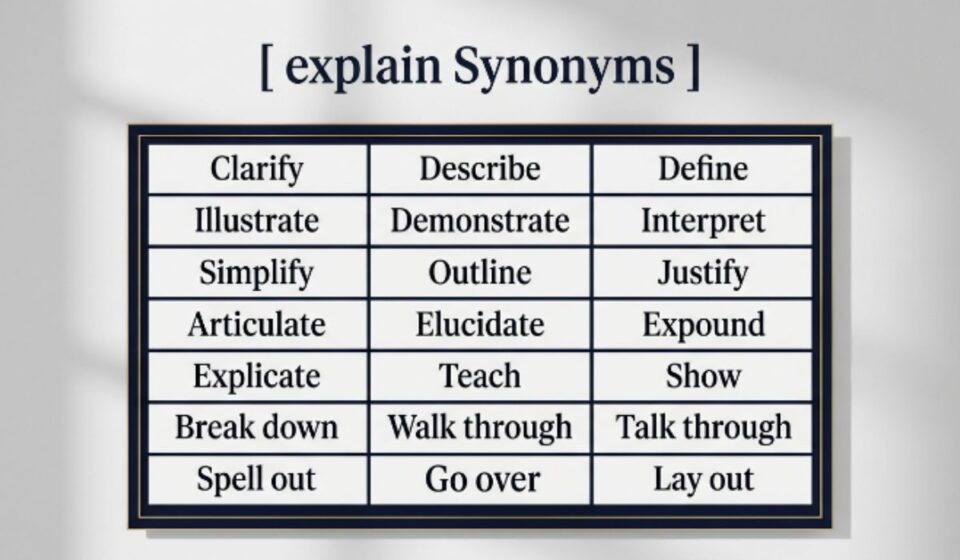
30 Synonyms for “Explain” and How to Use Them
Clarify
Meaning: “Clarify” means to remove confusion around a specific point, usually one that was already partly understood but muddled. It works best when there’s an existing misunderstanding to fix, rather than a brand-new topic to introduce. The word signals precision and care, as if the speaker wants to make sure nothing gets lost. It’s one of the most versatile alternatives on this list because it fits almost any setting.
Example: Could you clarify what you meant by “final draft”?
When It Fits: Perfect for emails and meetings when something someone said needs a second, clearer pass.
Describe
Meaning: “Describe” means to give details about what something looks like, feels like, or involves, without necessarily addressing reasons or causes. It’s a neutral, observational word, often used when the goal is simply to paint a picture for someone who wasn’t there. Unlike “explain,” it doesn’t imply the listener was confused beforehand.
Example: He described the accident in detail for the insurance report.
When It Fits: Useful when recounting events, appearances, or experiences rather than reasoning through them.
Define
Meaning: “Define” means to state the precise meaning of a word, term, or concept. It’s narrower than “explain,” since it applies specifically to meaning rather than process or cause. This word carries an academic, exact tone, and it works best when there’s a single correct answer being pinned down.
Example: The professor asked students to define “opportunity cost” in their own words.
When It Fits: Common in classrooms, glossaries, and any writing that introduces new terminology.
Illustrate
Meaning: Illustrate means to make an idea clear by using examples, comparisons, or visuals. It adds a layer that plain explanation doesn’t always include: something concrete the audience can picture. This word suggests effort to make an abstract idea tangible, which gives it a slightly more generous, audience-focused feel than a flat explanation.
Example: She used a pie chart to illustrate how the budget was divided.
When It Fits: Ideal for presentations, teaching materials, and any writing that benefits from a visual or example-based approach.
Demonstrate
Meaning: “Demonstrate” means to show something in action, proving how it works through a real example rather than just describing it in words. It carries a sense of evidence, as if the point is being proven, not just stated. This makes it a strong choice when credibility matters as much as clarity.
Example: The trainer demonstrated the correct lifting technique before letting anyone try it.
When It Fits: Great for tutorials, physical instructions, and any situation where showing beats telling.
Interpret
Meaning: “Interpret” means to explain the meaning or significance of something that isn’t immediately obvious, such as a law, a dream, a piece of art, or a set of data. It involves judgment, not just description, since the person interpreting is offering their understanding of something open to more than one reading.
Example: The analyst interpreted the sales dip as a seasonal pattern, not a real decline.
When It Fits: Fits naturally in legal, artistic, financial, or data-related discussions where meaning isn’t fixed.
Simplify
Meaning: “Simplify” means to make a complicated subject easier to follow, often by removing unnecessary detail or technical language. This word tells the reader the explanation was deliberately stripped down for their benefit. It carries a helpful, patient tone, useful when the audience isn’t familiar with a topic.
Example: The doctor simplified the diagnosis so the family could understand the next steps.
When It Fits: Works well when explaining technical or medical information to a general audience.
Outline
Meaning: “Outline” means to present the main points of something without going into full detail. It’s a structural word, focused on giving shape to information rather than fully explaining every part of it. This makes it a good fit for previews, summaries, or plans still in progress.
Example: She outlined the project timeline during the kickoff call.
When It Fits: Common in meetings, proposals, and any situation where a big-picture summary comes before the details.
Justify
Meaning: “Justify” means to give reasons that show an action or decision was fair, reasonable, or correct. Unlike most words on this list, it isn’t really about making something understandable. It’s about defending it. This word can carry a slightly defensive tone, so it’s worth using carefully.
Example: He struggled to justify the sudden price increase to longtime customers.
When It Fits: Best used when a decision is being questioned and a defense is genuinely needed.
Articulate
Meaning: Articulate means to express an idea or feeling clearly and effectively, often emphasizing how well something was said rather than just what was said. It highlights the speaker’s skill, suggesting the explanation was not only clear but also well-formed. This word works especially well when praising someone’s communication ability.
Example: She articulated her concerns without sounding accusatory.
When It Fits: Useful for describing thoughtful, well-organized communication, especially in feedback or performance reviews.
Elucidate
Meaning: Elucidate means to make a difficult or complex subject clear, typically in formal or academic writing. It’s a heavier, more literary word than “clarify,” and it signals real intellectual effort behind the explanation. Overusing it in everyday speech can sound stiff, so it works best in writing meant to sound formal.
Example: The report elucidated the long-term risks buried in the original proposal.
When It Fits: Appropriate for academic papers, formal reports, or expert commentary.
Expound
Meaning: Expound means to explain a subject in considerable depth, often building out an idea over several points rather than a single sentence. It implies a longer, more developed explanation, not a quick clarification. This word fits situations where someone is genuinely elaborating, not just answering a quick question.
Example: The lecturer expounded on the causes of the economic collapse for nearly an hour.
When It Fits: Fits long-form discussions, lectures, or detailed written analysis.
Explicate
Meaning: “Explicate” means to explain something in a detailed, methodical way, often used specifically for texts, arguments, or ideas that need careful unpacking. It’s a formal, almost academic word, and it works best when precision matters more than warmth. It signals a step-by-step, thorough approach.
Example: The professor explicated the poem’s central metaphor line by line.
When It Fits: Best suited for literary analysis, academic writing, and close readings of complex material.
Teach
Meaning: “Teach” means to help someone understand or learn something, usually through instruction over time rather than a single explanation. It implies a relationship between a knowledgeable person and a learner, and it carries an educational, patient tone. Unlike a quick explanation, teaching often assumes repetition and practice.
Example: My grandfather taught me how to change a tire when I was sixteen.
When It Fits: Ideal for skill-building, mentorship, and any situation involving ongoing instruction.
Show
Meaning: “Show” means to make something understood by presenting it directly, often visually or through action, rather than describing it in words. It’s one of the simplest and most casual words on this list, and it works well when a demonstration would communicate faster than a sentence ever could.
Example: Just show me how the machine starts up, and I’ll figure out the rest.
When It Fits: Natural in casual conversation, hands-on training, and quick, informal instructions.
Break Down
Meaning: “Break down” means to divide a complicated idea into smaller, more manageable parts so it’s easier to follow. This phrase suggests patience and structure, as if the explanation is being built piece by piece rather than delivered all at once. It’s especially useful when a topic feels overwhelming as a whole.
Example: Can you break down the contract terms so I know what I’m actually agreeing to?
When It Fits: Works well for financial, legal, or technical topics that benefit from a step-by-step approach.
Walk Through
Meaning: “Walk through” means to guide someone through a process step by step, usually in real time or in a structured sequence. It implies a shared, guided experience rather than a one-way explanation. This phrase feels collaborative, as if the speaker is right there alongside the listener.
Example: Let me walk you through the setup so you don’t miss a step.
When It Fits: Common in tech support, onboarding, and any hands-on instructional setting.
Talk Through
Meaning: “Talk through” means to discuss something carefully and thoroughly, often to work out confusion or make a decision together. Unlike a one-sided explanation, this phrase suggests a back-and-forth conversation, not just information delivered from one person to another.
Example: Before we sign anything, let’s talk through the pros and cons as a team.
When It Fits: Fits collaborative conversations, negotiations, and situations involving joint decision-making.
Spell Out
Meaning: “Spell out” means to state something in plain, unambiguous terms, leaving no room for misinterpretation. This phrase is often used when a previous explanation wasn’t clear enough or when the stakes of misunderstanding are high. It has a slightly blunt, no-nonsense tone.
Example: The manager spelled out exactly what would happen if deadlines were missed again.
When It Fits: Useful when clarity is critical and vague language has caused problems before.
Go Over
Meaning: “Go over” means to review information, often material that’s already been introduced, to reinforce understanding or catch anything missed. It has a casual, low-pressure tone and doesn’t necessarily imply the listener was confused, just that a review is useful.
Example: Let’s go over the meeting notes before we send them to the client.
When It Fits: Natural for casual check-ins, reviews, and everyday workplace conversations.
Lay Out
Meaning: Lay out means to present facts, plans, or options in an organized, easy-to-follow way. It carries a sense of structure, as if the information is being arranged neatly for the listener rather than delivered in a rush. This phrase suits situations involving choices or next steps.
Example: She laid out three possible timelines before asking the client to choose one.
When It Fits: Fits proposals, planning discussions, and situations involving multiple options.
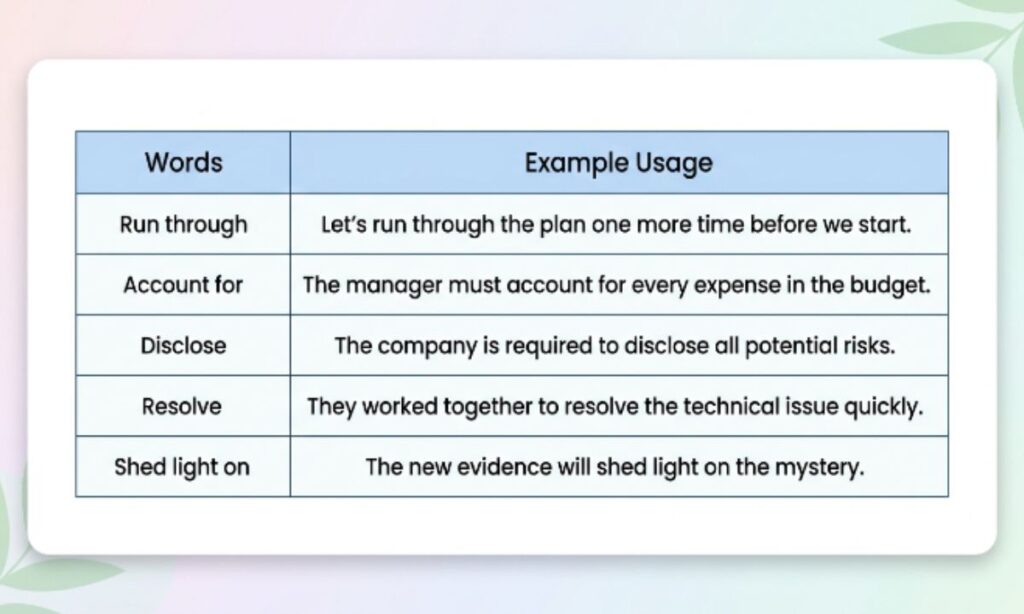
Run Through
Meaning: Run through means to give a quick summary or review, usually covering the main points without dwelling on every detail. It’s faster and less formal than a full explanation, and it implies familiarity with the material already exists on some level.
Example: Can you run through the agenda before everyone joins the call?
When It Fits: Great for quick briefings, rehearsals, and last-minute recaps.
Account For
Meaning: “Account for” means to give a reason or explanation for something, often something unexpected or requiring justification. It leans closer to “justify” than to “clarify,” since it usually responds to a question like “why did this happen?” rather than “what does this mean?”
Example: The report failed to account for the sudden drop in overseas sales.
When It Fits: Useful in analysis, reporting, and situations explaining a gap, discrepancy, or unexpected outcome.
Disclose
Meaning: Disclose means to reveal information that was previously private, hidden, or not publicly known. It’s not about making something easier to understand but about making it known in the first place. This word carries legal and formal weight, often implying an obligation to share.
Example: The company disclosed the data breach three days after discovering it.
When It Fits: Fits legal, financial, and corporate contexts involving formal or required transparency.
Resolve
Meaning: “Resolve” means to settle a contradiction, confusion, or dispute by explaining what actually happened or what’s actually true. It’s often used when two pieces of information seem to conflict, and the explanation clears up which one is accurate, or how both can be true.
Example: The investigation resolved the confusion over who authorized the payment.
When It Fits: Appropriate for conflicts, discrepancies, or situations needing a definitive answer.
Shed Light On
Meaning: “Shed light on” means to provide insight into something that was previously unclear or mysterious, often gradually rather than all at once. It has a slightly poetic, gentle tone, suggesting new understanding is emerging rather than being forcefully delivered.
Example: The interview shed light on why she left her previous job so suddenly.
When It Fits: Works well in journalism, storytelling, and situations involving gradually revealed understanding.
Decode
Meaning: Decode means to figure out and explain the meaning of something confusing, hidden, or written in unfamiliar terms. It suggests real effort was needed to get to the meaning, as if the information wasn’t handed over freely but had to be worked out.
Example: It took the analyst a full day to decode the outdated spreadsheet formulas.
When It Fits: Fits technical, coded, or deliberately confusing material that requires real effort to understand.
Analyze
Meaning: Analyze means to examine something closely to explain its parts, causes, or significance. It’s a more investigative word than “explain,” implying a careful, methodical process rather than a quick answer. It works especially well for data, arguments, or complex situations.
Example: The consultant analyzed the survey results before presenting recommendations.
When It Fits: Suited to research, reports, and any explanation built on careful examination of evidence.
Summarize
Meaning: “Summarize” means to explain the main points of something briefly, leaving out minor details. Unlike a full explanation, a summary is intentionally short, giving the listener just enough to understand the core idea without extra depth.
Example: Could you summarize the article in a few sentences for the newsletter?
When It Fits: Ideal for briefings, recaps, and any situation where brevity matters more than completeness.
Unpack
Meaning: “Unpack” means to explain something complicated by examining it piece by piece, often revealing layers or implications that weren’t obvious at first glance. It has a modern, conversational tone and works well for emotionally or intellectually loaded topics.
Example: Let’s unpack why that decision felt so unfair to the whole team.
When It Fits: Fits casual but thoughtful conversations, especially around emotions, motives, or complex opinions.
Which Alternative Is Best?
The right word depends entirely on the setting and the kind of explaining actually happening.
- Work and professional writing: outline, break down, account for
- Emails: clarify, spell out, lay out
- Academic assignments: define, interpret, explicate
- Teaching and instructions: teach, walk through, demonstrate
- Conversations with friends: talk through, unpack, go over
- Customer service: clarify, walk through, show
- Explaining a complex technical subject: simplify, break down, decode
- Giving a reason for a decision: justify, account for, resolve
The reasoning is simple. Formal settings call for words with a precise, considered tone. Casual settings call for phrasal verbs that sound like natural speech. And whenever the goal shifts from “make this clear” to “defend this choice,” words like justify and account for do a better job than clarify or describe ever could.
Common Mistakes When Replacing “Explain”
Treating every synonym as interchangeable. Not all 30 words mean the same thing. Swapping “explain” for “justify” when you just meant “clarify” changes the tone of the whole sentence, sometimes making it sound defensive when it wasn’t meant to.
Using formal words like “elucidate” in casual conversation. Telling a friend you’ll “elucidate” your weekend plans sounds odd and overly stiff. Save formal words for formal writing.
Using “justify” when you mean “make clear.” “She justified how the printer works” doesn’t make sense, because a printer’s function doesn’t need defending. The corrected version, “she explained how the printer works” or “she demonstrated how the printer works,” fits the meaning.
Using “describe” when the reader actually needs a reason. “He described why the flight was delayed” sounds slightly off. “He explained why the flight was delayed” or “he accounted for the delay” better matches the intent.
Ignoring preposition patterns. Phrases like “shed light on” and “account for” need their prepositions to work correctly. Dropping them, as in “shed light the situation,” breaks the grammar.
Quick Guide Table
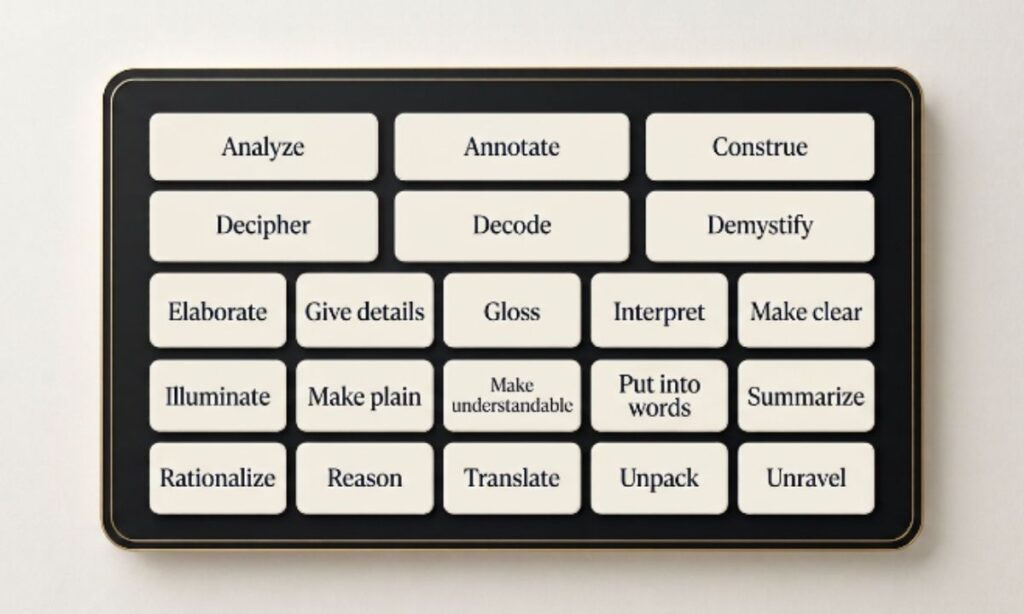
Beyond the 30 alternatives already covered, a few more words and phrases are worth knowing, especially for tone-matching in specific situations. This table gives a fast way to check whether a word fits a formal report, a casual chat, a quick email, or a spoken conversation, without rereading a full explanation each time.
| Phrase | Formal | Casual | Conversation | |
| Account for | Yes | Usually avoid | Yes | Sometimes |
| Annotate | Yes | Usually avoid | Sometimes | Usually avoid |
| Construe | Yes | Usually avoid | Sometimes | Usually avoid |
| Decipher | Sometimes | Yes | Sometimes | Yes |
| Demystify | Sometimes | Yes | Yes | Yes |
| Disentangle | Yes | Usually avoid | Sometimes | Usually avoid |
| Decode | Sometimes | Yes | Sometimes | Yes |
| Gloss | Yes | Usually avoid | Sometimes | Usually avoid |
| Illuminate | Yes | Sometimes | Yes | Sometimes |
| Rationalize | Yes | Sometimes | Sometimes | Yes |
| Resolve | Yes | Sometimes | Yes | Sometimes |
| Spell out | Sometimes | Yes | Yes | Yes |
| Translate | Yes | Yes | Yes | Yes |
| Unravel | Sometimes | Yes | Sometimes | Yes |
| Make clear | Sometimes | Yes | Yes | Yes |
Conclusion
No single synonym replaces “explain” perfectly in every sentence, because each one carries its own shade of meaning. The best choice comes down to what actually happened: clarifying, justifying, teaching, or simplifying. Pick the word that matches your intent, and your writing will sound sharper and more precise than repeating “explain” ever could.

[…] 30 Synonyms for “Explain” With Examples […]