
Using “ability” in every other sentence makes your writing sound thin. The word works, but it’s generic, and generic words don’t stick with readers. Picking the right alternative helps you say exactly what kind of skill, power, or potential you actually mean.
What Does “Ability” Really Mean?
The word “ability” refers to the power, skill, or capacity to do something successfully. It can describe a talent you’re naturally good at or a skill you’ve developed through practice and experience. Because it applies to so many situations, it’s one of the most common words people use when talking about what someone can do.
Imagine someone learning to drive for the first time. At the beginning, even simple tasks can feel stressful. After a few weeks of steady practice, they might proudly say, “I finally can parallel park without getting nervous.” That ability didn’t appear overnight. It came from patience, repetition, and learning from mistakes.
The word also fits many different types of strengths. An athlete has the ability to complete a marathon after months of training. A teacher has the ability to explain difficult ideas in a way students understand.
A musician has the ability to perform confidently on stage, while a leader has the ability to keep a team focused during stressful moments. Since the word works in almost every setting, it can sometimes feel too general if it’s used repeatedly.
Why Look for Alternatives?
Using the same word over and over makes writing feel repetitive. When ability appears in nearly every sentence, readers stop paying attention to it, and your message loses some of its impact.
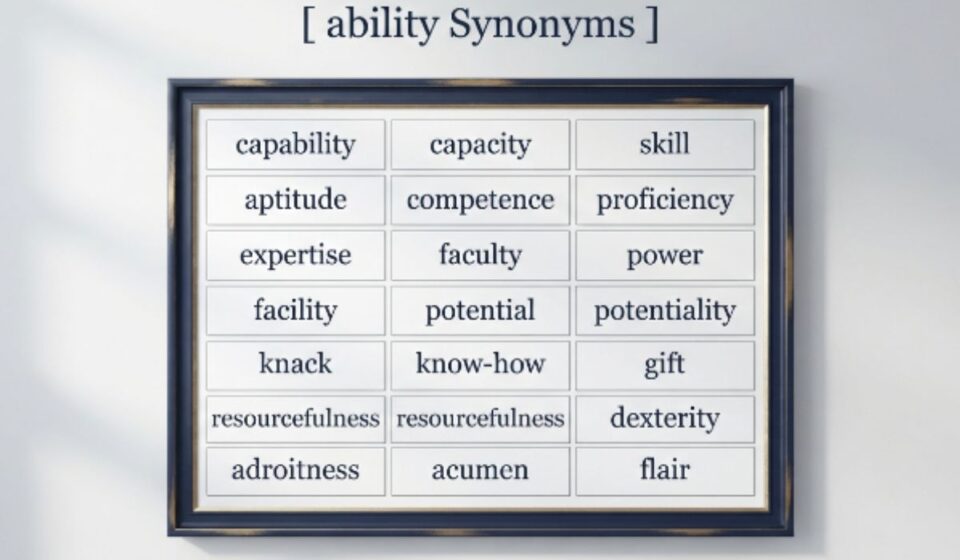
Choosing a more specific alternative creates a clearer picture. Aptitude suggests natural talent. Expertise highlights years of knowledge and experience. Knack describes a skill that seems to come easily, while capability often refers to someone’s overall capacity to perform a task. Each option adds a slightly different meaning and helps your writing sound more natural.
This matters in resumes, essays, emails, and everyday conversations. Replacing repeated uses of ability with the right synonym improves readability, keeps your writing interesting, and shows that you’ve carefully matched the word to the situation.
25 Synonyms for “Ability” and How to Use Them
Capability
Meaning: “Capability” refers to the practical power to do something, often tied to what a person or system can currently handle. It leans toward measurable performance rather than raw talent. People use it when describing what someone is equipped to do right now.
Example: The new software has the capability to process orders twice as fast.
When It Fits: Great for technical writing, product descriptions, and workplace reports.
Capacity
Meaning: “Capacity” means the maximum amount someone or something can handle, whether that’s mental, physical, or emotional. It often implies a limit, not just raw skill. The word suggests how much a person can take on before reaching their edge.
Example: Her capacity for staying calm under pressure impressed the entire team.
When It Fits: Works well when discussing limits, workload, or emotional bandwidth.
Skill
Meaning: “Skill” is a learned ability, usually developed through practice and repetition. It’s the most direct, everyday synonym on this list. People understand it instantly, with no extra explanation needed.
Example: He picked up the skill of public speaking after years of practice.
When It Fits: Perfect for resumes, casual conversation, and everyday writing.
Talent
Meaning: “Talent” points to a natural gift someone is born with, rather than something learned over time. It carries a sense of ease, like the person didn’t have to work as hard to get there. The word often shows admiration.
Example: Her talent for painting was obvious even as a young child.
When It Fits: Use it when praising natural gifts in art, sports, or music.
Aptitude
Meaning: “Aptitude” describes a natural tendency to learn or perform well in a specific area. It’s less about current skill and more about potential. Teachers and career counselors use it often when predicting future success.
Example: The test revealed a strong aptitude for mathematics.
When It Fits: Common in education, career planning, and skills assessments.
Competence
Meaning: “Competence” means having enough skill or knowledge to do something adequately, without necessarily excelling. It’s a practical, no-frills word that focuses on meeting a standard. It doesn’t promise brilliance, just reliability.
Example: His competence in handling client complaints kept the team running smoothly.
When It Fits: Fits performance reviews, job descriptions, and professional writing.
Proficiency
Meaning: “Proficiency” means a high level of skill, usually developed through training or extended practice. It sits a step above basic competence, closer to real fluency. The word often shows up alongside specific, measurable skills.
Example: She listed her proficiency in three programming languages on her resume.
When It Fits: Ideal for resumes, certifications, and language or technical skills.
Expertise
Meaning: ‘Expertise” refers to deep, specialized knowledge built over years of focused experience. It goes beyond proficiency into mastery of a narrow field. People with expertise are usually seen as the person to ask.
Example: The company hired a consultant for her expertise in supply chain logistics.
When It Fits: Best for professional bios, consulting, and specialized fields.
Faculty
Meaning: “Faculty” describes a natural mental or physical power, like memory, reasoning, or speech. It’s a slightly formal, older-sounding word compared to the rest of this list. It often appears in descriptions of the mind rather than physical skill.
Example: Even in his nineties, he retained a sharp faculty for recalling old stories.
When It Fits: Use it in formal or literary writing about mental sharpness.
Power
Meaning: Power, in this sense, means the inherent capacity to act, perform, or influence something. It’s broader and more forceful than most synonyms here. The word can apply to people, machines, or abstract forces.
Example: She lost the power of speech for a moment, stunned by the news.
When It Fits: Fits dramatic writing, storytelling, and emotionally charged moments.
Facility
Meaning: “Facility” describes an effortless, natural ease at doing something, almost like it comes without trying. It’s less common in casual speech but shows up in more polished writing. The word suggests smoothness rather than struggle.
Example: He showed a real facility for languages, picking up French within months.
When It Fits: Use it in formal or academic descriptions of natural ease.
Potential
Meaning: “Potential” refers to ability that hasn’t been fully developed or shown yet. It points forward, toward what someone could become rather than what they currently are. The word carries hope and possibility.
Example: The coach saw real potential in the young athlete’s footwork.
When It Fits: Great for mentoring, coaching, and early-career feedback.
Knack
Meaning: “Knack” means a natural, almost effortless skill for doing something specific, often something small or practical. It has a casual, warm tone, like a compliment given in passing. It’s rarely used for big, formal achievements.
Example: She has a knack for remembering everyone’s birthday without writing it down.
When It Fits: Perfect for casual conversation and lighthearted compliments.
Gift
Meaning: “Gift” describes a natural talent that feels almost given rather than earned. It leans emotional and appreciative, often used when praising someone sincerely. The word suggests the skill feels special, not ordinary.
Example: His gift for storytelling kept the whole room listening.
When It Fits: Use it in warm, personal, or celebratory writing.
Dexterity
Meaning: “Dexterity” refers to physical or mental skill, especially involving quick, precise movement or thinking. It’s most associated with hands-on tasks, but can describe mental agility too. The word feels technical and specific.
Example: The surgeon’s dexterity made the delicate procedure look effortless.
When It Fits: Fits descriptions of hands-on skills, sports, or fine motor tasks.
Adroitness
Meaning: “Adroitness” means cleverness and skill, especially in handling tricky or delicate situations. It’s a more formal, less common word than most on this list. It suggests quick thinking under pressure.
Example: Her adroitness in the negotiation kept both sides satisfied.
When It Fits: Best for formal writing about negotiation, diplomacy, or strategy.
Acumen
Meaning: “Acumen” describes sharp judgment and quick understanding, especially in business or practical matters. It implies both intelligence and experience working together. The word carries a confident, professional tone.
Example: His business acumen turned a struggling shop into a thriving brand.
When It Fits: Common in business writing, leadership bios, and professional praise.
Flair
Meaning: “Flair” means a natural, stylish talent for doing something in a way that stands out. It’s closely tied to creativity and personal style, not just raw competence. The word implies the person makes it look good, not just correct.
Example: She has a flair for turning simple outfits into something memorable.
When It Fits: Great for creative fields like fashion, design, and writing.
Resourcefulness
Meaning: “Resourcefulness” means the ability to find quick, clever solutions with whatever is available. It focuses on problem-solving under limited conditions, not raw talent. The word suggests adaptability more than skill.
Example: His resourcefulness kept the camping trip on track after the gear went missing.
When It Fits: Fits stories about problem-solving, survival, or tight situations.
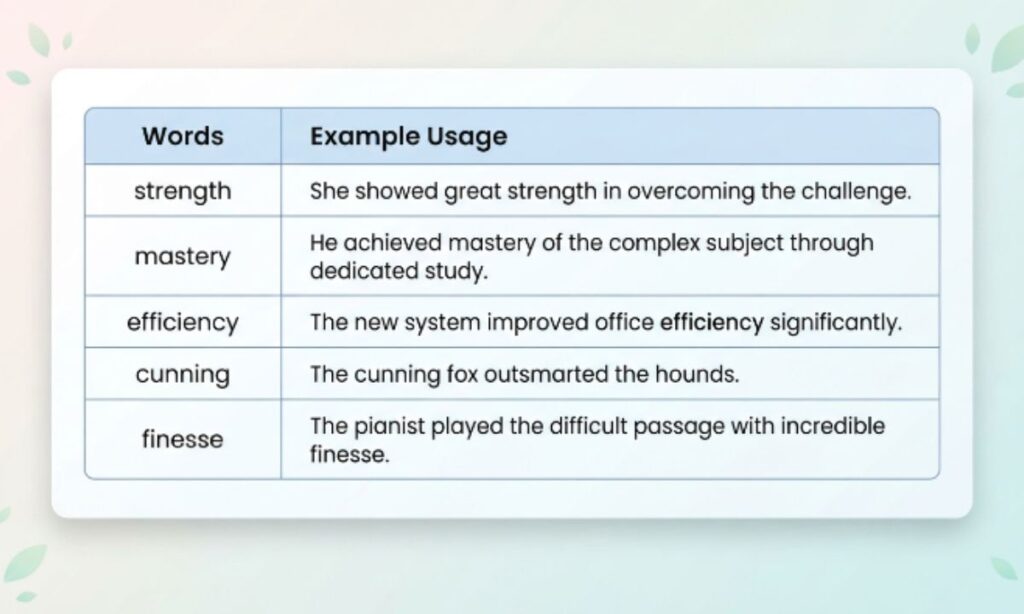
Mastery
Meaning: “Mastery” refers to complete, expert-level control over a skill, usually earned through years of dedicated practice. It sits above proficiency and expertise on the skill ladder. The word “implies” near-total command.
Example: Her mastery of the violin took over a decade of daily practice.
When It Fits: Best for describing top-tier, long-earned skill.
Strength
Meaning: Strength, in this context, means a particular area where someone excels, not physical power. It’s common in self-assessments and feedback, pointing to a personal advantage. The word feels practical and easy to use.
Example: Attention to detail has always been one of her biggest strengths.
When It Fits: Fits interviews, performance reviews, and self-descriptions.
Know-how
Meaning: “Know-how” means practical knowledge and experience needed to get something done. It’s informal and grounded, focused on hands-on understanding rather than theory. The word feels approachable, almost conversational.
Example: He had the know-how to fix the leaky pipe without calling a plumber.
When It Fits: Perfect for casual conversation and practical, everyday skills.
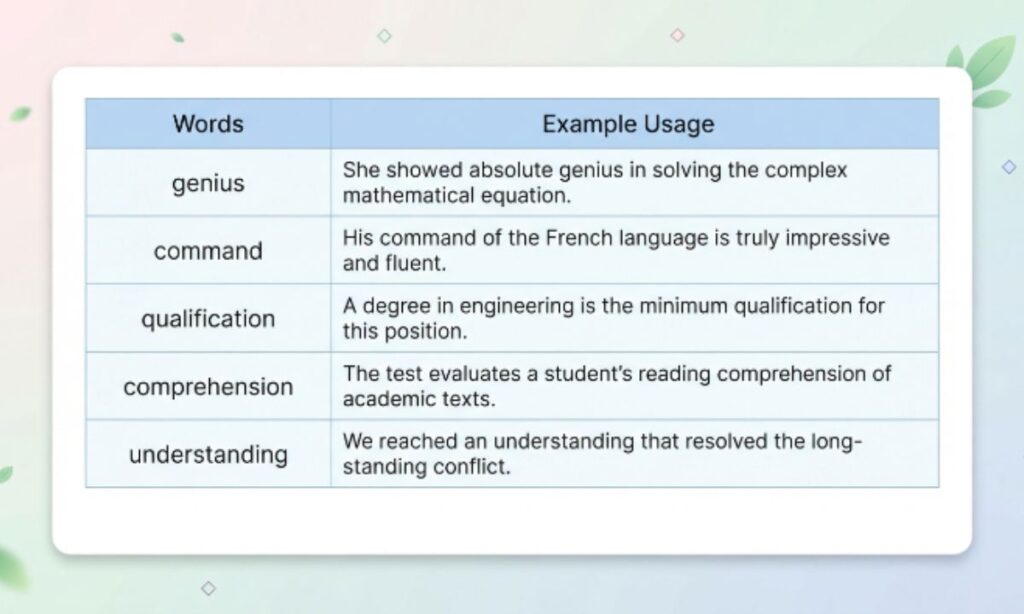
Qualification
Meaning: “Qualification” refers to the skills, experience, or credentials that make someone suited for a specific role or task. It’s tied closely to formal proof, like certificates or degrees. The word feels official rather than personal.
Example: Her qualifications made her the strongest candidate for the position.
When It Fits: Best for job applications, hiring, and formal evaluations.
Command
Meaning: “Command” means a strong, confident grasp of a skill, especially language or knowledge. It suggests control and authority, not just basic understanding. The word carries a slightly impressive, elevated tone.
Example: His command of Spanish impressed everyone at the conference.
When It Fits: Fits formal writing about language skill or subject mastery.
Prowess
Meaning: “Prowess” refers to exceptional skill or ability, especially in a demanding or competitive area. It has a bold, almost heroic tone compared to more neutral synonyms. The word suggests the person stands out clearly from others.
Example: The team’s defensive prowess carried them through the toughest matches.
When It Fits: Great for sports writing, competition, and impressive achievements.
Which Alternative Fits Best for Each Situation?
The best synonym for ability depends on who you’re speaking to and what you’re trying to say. Some words sound natural in everyday conversations, while others are a better fit for professional or academic writing. Choosing the right one makes your message clearer and more effective.
Work and business: Capability, competence, acumen, command, and qualification work well when discussing experience, job performance, or leadership.
Emails to colleagues: Proficiency, competence, capacity, and know-how keep your writing professional without sounding stiff.
Friends and casual chats: knack, know-how, gift, and skill feel relaxed and easy to understand.
School and academic writing: aptitude, faculty, potential, and proficiency fit essays, reports, and formal discussions.
Everyday conversation: “Skill,” “talent,” “knack,” and “strength” are simple choices that sound natural in most situations.
If you’re unsure which word to use, think about your audience first. Casual conversations usually sound better with everyday language, while workplace and academic settings often call for more precise terms.
Common Mistakes People Make
- Using formal words like adroitness or prowess in casual conversations.
- Treating talent and skill as the same, even though talent is often natural while skill is usually learned.
- Repeating the same synonym throughout a resume or article.
- Choosing uncommon words just to sound more impressive.
- Mixing formal and casual terms in the same paragraph, making the writing feel uneven.
Quick Comparison Table
| Phrase | Formal | Casual | Conversation | |
| Capability | Yes | No | Yes | Rarely |
| Capacity | Yes | No | Yes | Rarely |
| Skill | Yes | Yes | Yes | Yes |
| Talent | Yes | Yes | Yes | Yes |
| Aptitude | Yes | No | Yes | Rarely |
| Competence | Yes | No | Yes | No |
| Proficiency | Yes | No | Yes | Rarely |
| Expertise | Yes | No | Yes | Rarely |
| Faculty | Yes | No | Rarely | No |
| Power | Yes | Yes | Rarely | Yes |
| Facility | Yes | No | Rarely | No |
| Potential | Yes | Yes | Yes | Yes |
| Knack | No | Yes | Rarely | Yes |
| Gift | Rarely | Yes | Rarely | Yes |
| Dexterity | Yes | No | Rarely | No |
| Adroitness | Yes | No | No | No |
| Acumen | Yes | No | Yes | Rarely |
| Flair | Rarely | Yes | Rarely | Yes |
| Resourcefulness | Yes | Yes | Yes | Yes |
| Mastery | Yes | Rarely | Rarely | Rarely |
| Strength | Yes | Yes | Yes | Yes |
| Know-how | No | Yes | Rarely | Yes |
| Qualification | Yes | No | Yes | No |
| Command | Yes | Rarely | Rarely | Rarely |
| Prowess | Yes | Rarely | No | Rarely |
Frequently Asked Questions
What is the strongest synonym for ability?
Mastery and prowess both carry the strongest sense of exceptional, high-level skill.
Is ability the same as capability?
They’re close, but capability leans toward what someone can currently do, while ability covers both natural and learned skill more broadly.
What’s a casual way to say ability?
Knack, know-how, and skill all sound natural in relaxed, everyday conversation.
Which synonym works best on a resume?
Proficiency, competence, and qualification are the most fitting choices for resumes and job applications.
What is the opposite of ability?
Inability, incompetence, and incapacity are the most common opposites, each describing a different kind of shortfall.
Conclusion
Ability is a solid word, but it can’t carry every sentence on its own. These twenty-five alternatives let you point to natural talent, learned skill, or raw power with much more precision. Next time “ability” feels flat, reach for the word that actually matches what you’re describing.