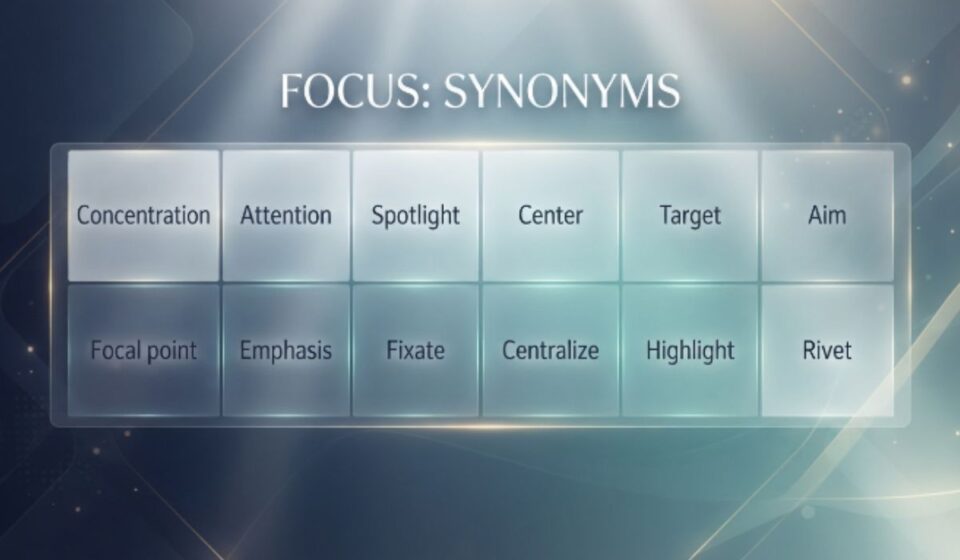

Repeating the same word over and over makes writing dull. “Focus” is a good word, but it gets old fast if you use it in every sentence. Select the best alternative to keep your writing crisp and your meaning clear.
The secret is to find a word that works at the time. A word that’s a synonym in an e-mail might sound stilted in a text to a friend. This guide will show you 25 real alternatives to “focus” with easy-to-understand definitions and examples you can copy now.
What Does “Focus” Really Mean?
“Focus” means to concentrate all of your attention on one thing. You tune out the noise and focus your efforts in one direction.
Picture a student preparing for a major test. She puts her phone away and only thinks of her notes, concentrating. That’s the basic idea. One goal, total focus, nothing else taking away from you.
Why Look for Alternatives?
The word “focus” is powerful, but it can’t do everything. Writing that repeats a word five times in one paragraph sounds repetitive and lazy.
Also, there’s a tone issue. In formal writing, the word “focus” can sound a bit generic, and in casual conversation a little stiff. Different situations call for different words, and this is where synonyms come into their own.
Some other options also have a sharper meaning. The precise suggestion is to zero in on. “Dwell on” is thinking too much. It’s more important to choose the right word than just say “focus.”
25 Synonyms for “Focus” and How to Use Them
Concentrate
Meaning: This means putting all your mental effort into one task. It’s the most common formal substitute for focus.
Example: She had to concentrate hard to finish the puzzle before dinner.
When It Fits: Use it in school, work, or any setting that involves mental effort.
Center On
Meaning: This means building everything around one main idea or topic. It works well when describing a plan or a discussion.
Example: The meeting will center on next quarter’s budget.
When It Fits: Great for business writing and project summaries.
Home In On
Meaning: This means narrowing your attention until you reach the exact point that matters. It suggests a process, not an instant switch.
Example: The detective began to home in on the real suspect.
When It Fits: Useful when describing investigation, research, or problem-solving.
Zero In On
Meaning: Similar to “home in on,” but with more urgency. It implies precision and speed.
Example: The coach told the team to zero in on their weakest player during practice.
When It Fits: Works well in sports, strategy, and fast-moving situations.
Direct Your Attention
Meaning: This means consciously pointing your mind toward something specific. It’s a more formal, deliberate phrase.
Example: Please direct your attention to the whiteboard.
When It Fits: Common in presentations, classrooms, and instructions.
Train Your Attention
Meaning: This means aiming your focus steadily at one thing, almost like aiming a camera lens.
Example: He trained his attention on the horizon, watching for the storm.
When It Fits: Fits descriptive or narrative writing, especially in stories.
Fix Your Attention
Meaning: This means locking your mind onto something and not letting it wander.
Example: Her eyes fixed her attention on the flickering candle.
When It Fits: Works well in creative or descriptive writing.
Fasten On
Meaning: This means holding tightly onto a thought or idea, sometimes to the point of obsession.
Example: He fastened on the idea of quitting his job and couldn’t let it go.
When It Fits: Useful for describing persistent thoughts or fixations.
Rivet
Meaning: This means capturing someone’s attention so completely they can’t look away.
Example: The performance riveted the entire audience.
When It Fits: Perfect for describing gripping stories, movies, or speeches.
Channel Your Energy
Meaning: This means directing your effort into one productive outlet instead of spreading it thin.
Example: She channeled her energy into finishing the marathon.
When It Fits: Common in motivational or personal development writing.
Prioritize
Meaning: This means deciding what matters most and putting your effort there first.
Example: You need to prioritize your health before your workload.
When It Fits: Ideal for workplace advice and productivity content.
Emphasize
Meaning: This means giving something extra weight or importance in what you say or do.
Example: The report emphasized the need for faster shipping times.
When It Fits: Common in business writing and formal reports.
Spotlight
Meaning: This means putting something in the center of attention, often publicly.
Example: The article spotlighted three small businesses in the area.
When It Fits: Works well in journalism, marketing, and features.
Pinpoint
Meaning: This means identifying something with exact precision.
Example: The mechanic pinpointed the noise coming from the engine.
When It Fits: Useful in technical or diagnostic writing.
Hone
Meaning: This means sharpening your attention or skill through repeated effort.
Example: She spent years honing her focus during long training sessions.
When It Fits: Fits personal growth, sports, and skill-based writing.
Attend To
Meaning: This means giving something the care or attention it needs.
Example: He attended to the customer’s complaint right away.
When It Fits: Common in customer service and professional settings.
Dwell On
Meaning: This means thinking about something for too long, often in a negative way.
Example: Try not to dwell on the mistake, and move forward instead.
When It Fits: Useful in advice columns or emotional support writing.
Dedicate Yourself To
Meaning: This means committing your time and energy fully to one goal.
Example: He dedicated himself to learning the language in six months.
When It Fits: Fits personal stories, goals, and achievements.
Immerse Yourself In
Meaning: This means becoming completely absorbed in an activity or environment.
Example: She immersed herself in the new culture during her trip abroad.
When It Fits: Great for travel writing and personal experiences.
Absorb Yourself In
Meaning: This means becoming so involved in something that you lose track of everything else.
Example: He absorbed himself in the novel and forgot about dinner.
When It Fits: Fits casual storytelling and personal reflections.
Narrow Down
Meaning: This means reducing a broad set of options until only the most important ones remain.
Example: We narrowed down the list to three final candidates.
When It Fits: Common in decision-making and business writing.
Key In On
Meaning: This means paying close attention to one detail that stands out.
Example: The analyst keyed in on a small change in the sales numbers.
When It Fits: Useful in data-driven or analytical writing.
Lock Onto
Meaning: This means fixing your attention firmly, almost like a machine tracking a target.
Example: The camera locked onto the runner as she crossed the finish line.
When It Fits: Works well in technical, sports, or action writing.
Point Toward
Meaning: This means directing effort or attention in a specific direction.
Example: All the evidence points toward one clear conclusion.
When It Fits: Fits argument-based or persuasive writing.
Sharpen Your Attention
Meaning: This means making your focus more precise and alert, often after a distraction.
Example: A short break can help sharpen your attention before a big task.
When It Fits: Common in productivity and wellness content.
Which Alternative Should You Choose?
For work and professional writing, “prioritize,” “center on,” and “emphasize” sound polished without being stiff. They’re safe choices for reports, meetings, and presentations.
In emails, “direct your attention” and “attend to” strike the right formal tone. They’re clear and don’t feel overly casual.
With friends or in everyday conversation, simpler phrases like “zero in on,” “dwell on,” or “lock onto” sound more natural. They match how people actually talk.
For school assignments, “concentrate” and “hone” work well since teachers expect clear, direct language. And in storytelling, words like “rivet,” “immerse yourself in,” and “fasten on” add color and emotion that plain “focus” can’t offer.
Common Mistakes
People often use these words without checking if the tone matches. “Rivet” in a business email sounds odd, even though it’s a valid synonym.
Another mistake is forcing a synonym where “focus” already works fine. Not every sentence needs to be rewritten just for variety.
Some writers also mix formal and casual words in the same paragraph, which breaks the flow. Keep your tone consistent.
Overusing intense words like “obsess” or “fixate” can also make writing sound dramatic when it doesn’t need to be. Match the intensity of the word to the actual situation.
Finally, some people forget that certain phrases need the right preposition. “Center on” and “home in on” don’t work the same way as “focus,” so check the sentence structure before swapping words.
Quick Comparison Table
| Phrase | Formal | Casual | Conversation | |
| Concentrate | Yes | Yes | Yes | Yes |
| Center on | Yes | No | Yes | No |
| Zero in on | No | Yes | No | Yes |
| Prioritize | Yes | No | Yes | No |
| Dwell on | No | Yes | No | Yes |
| Rivet | No | Yes | No | Yes |
| Attend to | Yes | No | Yes | No |
| Hone | Yes | Yes | Yes | Yes |
Frequently Asked Questions
What’s the simplest word to replace “focus”?
“Concentrate” is the easiest, most natural swap in almost any context.
Which synonym works best in a professional email?
“Direct your attention” or “prioritize” both sound polished and clear.
Is “zero in on” too casual for school writing?
It’s borderline. Stick with “concentrate” or “hone” for formal assignments.
Can I use “rivet” for a person instead of a performance?
Yes, if someone’s presence or story completely captures attention.
Do all these synonyms mean thing?
No. Each one adds its own shade of meaning, so context always matters.
Conclusion
“Focus” is a solid word, but it can’t carry every sentence on its own. These 25 alternatives give you more precision, more tone control, and more room to sound natural. Pick the one that matches your setting, and your writing will feel sharper right away.