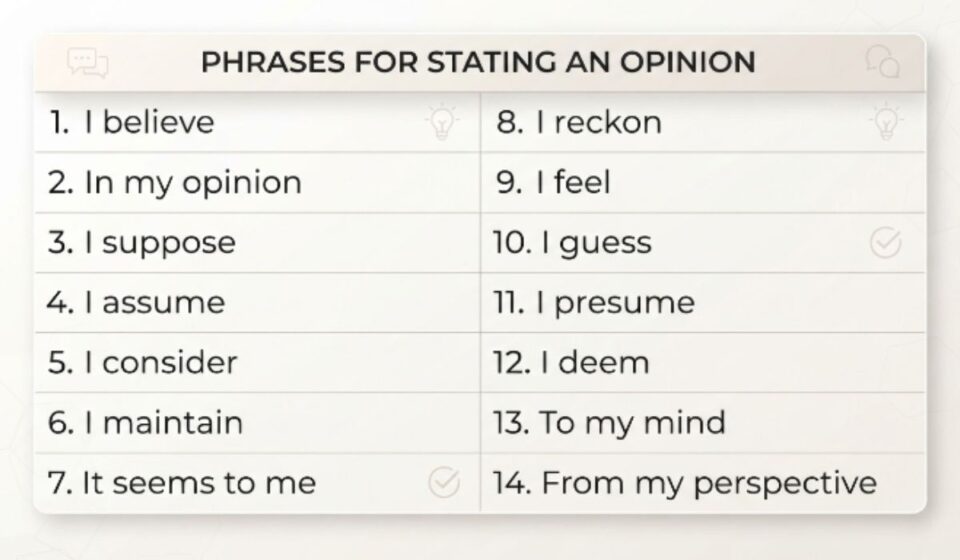

Many of us use the phrase “I think” too often, which makes it lose its impact. You find it in emails, during meetings, and in casual conversations with friends. It has become the same as an opinion, a thought, or even a casual comment.
Introducing variety enhances your writing and helps others differentiate between your concrete statements and your viewpoints. There’s a significant distinction between asserting, “The sky is blue,” and saying, “In my view, the sky is the most beautiful color.”
This guide addresses “I think” statements—defining what they are, understanding when they become ineffective, and offering alternative phrases to use instead. It includes 25 potential variations.
What Does “I Think” Really Mean?
“I think” is used to express an opinion, assumption, or intention, not to state something as a definite fact.
For example, if a colleague asks whether a certain project deadline can be met, a response could be, “I think we can manage to meet it, but it will be a close call.” Here, the phrase “I think” conveys uncertainty about meeting the deadline. Therefore, the statement is simply an opinion and a genuine assessment of the situation.
Why Look for Alternatives?
“I think” is helpful, but it’s also one of the most overused phrases in English. When you use it three or four times in one conversation or email, it can start to sound like a habit rather than a real opinion.
It can also seem unsure or vague, especially in professional situations where people prefer clearer language. If you’re writing a report, giving feedback, or arguing for something, using stronger or more specific phrases can make you sound more credible and less repetitive.
25 Better “I think” Synonyms
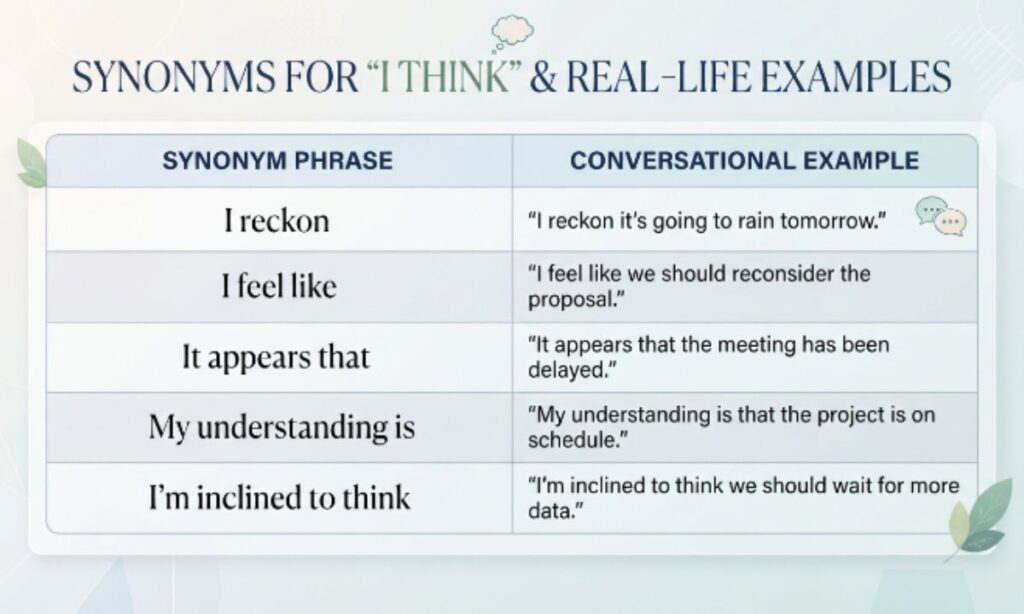
1. In my opinion
Meaning: A straightforward way to introduce a personal viewpoint. It works well when you want to separate fact from your own take clearly.
Example: “In my opinion, the new layout is easier to navigate than the old one.”
When It Fits: Formal writing, presentations, or debates where clarity matters.
2. I believe
Meaning: Suggests a stronger sense of conviction than “I think.” It implies you’ve considered the matter and stand behind it.
Example: “I believe this approach will save us time in the long run.”
When It Fits: Job interviews or situations where you want to sound confident but not pushy.
3. It seems to me
Meaning: A gentler phrase that leaves room for being wrong. It works well when you’re observing something rather than stating a firm belief.
Example: “It seems to me that the team is more motivated since the new schedule started.”
When It Fits: Giving feedback without sounding like you’re issuing a verdict.
4. From my perspective
Meaning: Highlights that your view comes from your own experience or position, not a universal truth. It’s useful when others might see things differently.
Example: “From my perspective, remote work has actually improved our output.”
When It Fits: Group discussions where multiple viewpoints are being compared.
5. As I see it
Meaning: A casual but clear way to frame your opinion. It sounds a bit more personal and grounded than formal alternatives.
Example: “As I see it, we have two options here, and neither one is perfect.”
When It Fits: Conversations with colleagues or friends where you’re weighing choices together.
6. My take is
Meaning: A modern, conversational way to share an opinion, often used when discussing something informal like a movie, trend, or event.
Example: “My take is that the sequel wasn’t as good as the original.”
When It Fits: Casual chats, social media, or texting with friends.
7. I’d say
Meaning: A quick, low-pressure way to offer an opinion without sounding too formal or forceful.
Example: “I’d say we’re about halfway through the project at this point.”
When It Fits: Quick check-ins or casual updates at work.
8. I suspect
Meaning: Implies you have a hunch based on some evidence, even if you’re not fully certain. It carries a slight tone of curiosity or caution.
Example: “I suspect the delay has more to do with staffing than budget.”
When It Fits: When you’re guessing at a cause or explanation for something.
9. I reckon
Meaning: A relaxed, informal phrase often associated with everyday speech. It works well in casual, friendly settings.
Example: “I reckon we’ll finish before lunch if we keep this pace.”
When It Fits: Talking with friends or family, not formal writing.
10. I feel like
Meaning: Leans more on emotion or instinct than logic. It’s common in everyday speech when you’re describing a gut reaction.
Example: “I feel like this restaurant has gotten more crowded lately.”
When It Fits: Casual conversations where you’re sharing an impression, not a fact.
11. It appears that
Meaning: A more formal, observational phrase. It suggests you’re basing your opinion on visible evidence rather than pure instinct.
Example: “It appears that sales have slowed down since the price increase.”
When It Fits: Reports, analysis, or professional writing.
12. My understanding is
Meaning: Signals that your opinion is based on information you’ve gathered, though you’re open to being corrected.
Example: “My understanding is that the meeting got pushed to Thursday.”
When It Fits: Clarifying details in emails or team conversations.
13. I’m inclined to think
Meaning: A slightly more thoughtful, deliberate way of saying you lean toward a certain view, without fully committing.
Example: “I’m inclined to think we should wait until next quarter to launch.”
When It Fits: Careful decision-making conversations, especially in business.
14. If you ask me
Meaning: A direct, informal phrase that signals you’re about to give your honest, unfiltered opinion.
Example: “If you ask me, the shorter meetings have made us more productive.”
When It Fits: Casual conversations where people expect a candid answer.
15. I’d guess
Meaning: Openly admits you’re estimating rather than stating something with certainty.
Example: “I’d guess the event will draw around two hundred people.”
When It Fits: Situations involving rough estimates, like numbers or timing.
16. I have a feeling
Meaning: Suggests intuition rather than solid reasoning. It’s often used when you can’t fully explain why you believe something.
Example: “I have a feeling this client is going to ask for changes again.”
When It Fits: Predicting outcomes based on experience or instinct.
17. In my view
Meaning: Similar to “in my opinion” but slightly more formal and often used in writing rather than speech.
Example: “In my view, the current policy needs a few small adjustments.”
When It Fits: Reports, essays, or formal emails.
18. I gather
Meaning: Implies your opinion is based on secondhand information or context clues rather than direct knowledge.
Example: “I gather the budget got cut, based on how quiet everyone’s been.”
When It Fits: When you’re piecing together an opinion from indirect sources.
19. I assume
Meaning: Indicates you’re making a reasonable guess based on what’s typical or expected, though you haven’t confirmed it.
Example: “I assume the store will be closed on the holiday, like usual.”
When It Fits: Everyday planning or scheduling conversations.
20. I imagine
Meaning: A softer way to guess at something, often used when picturing how a situation might play out.
Example: “I imagine traffic will be worse than usual with the game tonight.”
When It Fits: Casual predictions about everyday situations.
21. My hunch is
Meaning: A very informal way to describe an instinct-based opinion, often without much evidence behind it.
Example: “My hunch is that the new hire will do well once she settles in.”
When It Fits: Friendly chats, not professional documents.
22. I would argue
Meaning: A stronger, more assertive phrase often used to introduce a debatable point you’re prepared to defend.
Example: “I would argue that flexible hours matter more to employees than a higher salary.”
When It Fits: Essays, debates, or persuasive writing.
23. To my mind
Meaning: A slightly old-fashioned but still natural way to introduce a personal opinion, often found in writing.
Example: “To my mind, the simplest solution is usually the best one.”
When It Fits: Thoughtful essays or reflective writing.
24. I’m of the opinion that
Meaning: A more formal, deliberate way to state a belief. It works well when you want to sound measured and considered.
Example: “I’m of the opinion that the training program needs more hands-on practice.”
When It Fits: Formal meetings, reviews, or written recommendations.
25. It strikes me that
Meaning: Suggests a realization or observation that just occurred to you, rather than a long-held belief.
Example: “It strikes me that we’ve never actually asked customers what they want.”
When It Fits: Moments of reflection during discussions or brainstorming.
Which Alternative Should You Choose?
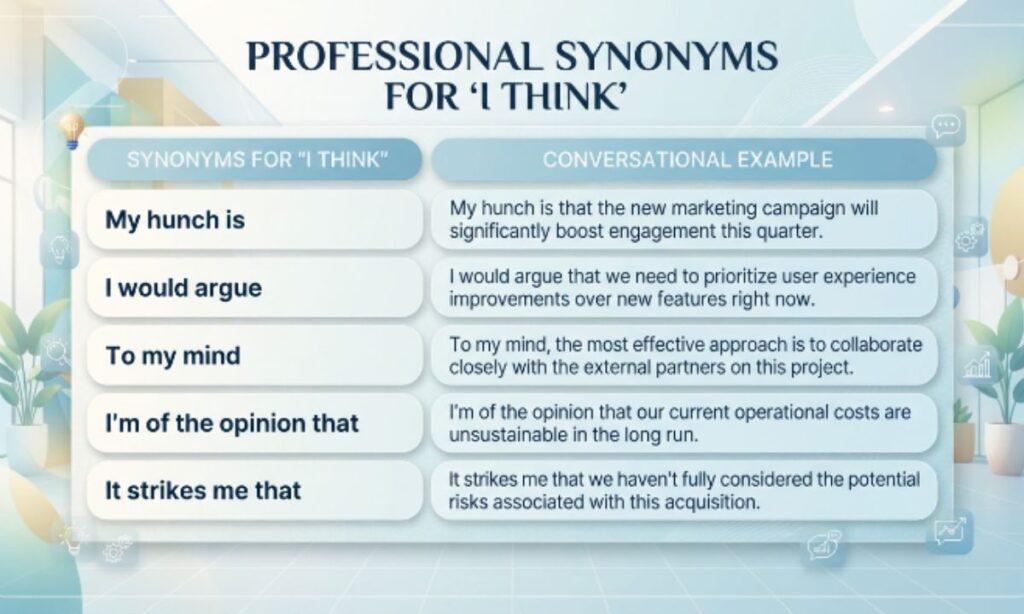
For work: “In my opinion,” “I’m of the opinion that,” and “I would argue” sound professional and confident without being pushy.
For emails: “My understanding is…” “It appears that,” and “In my view” strike a good balance between polite and clear.
For friends: “I reckon,” “My take is,” and “If you ask me” feel natural and relaxed.
For school: “I would argue,” “To my mind,” and “In my view” fit well in essays and class discussions.
For everyday conversation: “I feel like,” “I have a feeling,” and “I’d say” are easy, low-pressure choices.
Common Mistakes
- Utilizing formal language in casual conversations: Phrasing “I’m of the opinion” to a friend via text may come across as overly pretentious and formal.
- Repeatedly using the same alternative: Continuously substituting “I think” with “I feel like” in every single statement could develop an undesirable habit.
- Misinterpreting one substitute for another: “I believe” and “I assume” are not interchangeable, so using one instead of the other can alter the meaning of the sentence and its intended message.
- Inserting the phrase when unnecessary: In certain situations, the most powerful opinion can be conveyed plainly without a verbose introduction.
- Neglecting to acknowledge the influence of tone: Using excessively casual expressions when a more formal tone is required could diminish the effectiveness of an idea.
Quick Comparison Table
| Phrase | Formal | Casual | Conversation | |
| In my opinion | Yes | No | Yes | Yes |
| I believe | Yes | Yes | Yes | Yes |
| It seems to me | Yes | Yes | Yes | Yes |
| From my perspective | Yes | No | Yes | Yes |
| As I see it | No | Yes | Yes | Yes |
| My take is | No | Yes | No | Yes |
| I’d say | No | Yes | No | Yes |
| I suspect | Yes | Yes | Yes | Yes |
| I reckon | No | Yes | No | Yes |
| I feel like | No | Yes | No | Yes |
| It appears that | Yes | No | Yes | No |
| My understanding is | Yes | No | Yes | Yes |
| I’m inclined to think | Yes | No | Yes | Yes |
| If you ask me | No | Yes | No | Yes |
| I’d guess | No | Yes | No | Yes |
| I have a feeling | No | Yes | No | Yes |
| In my view | Yes | No | Yes | Yes |
| I gather | Yes | Yes | Yes | Yes |
| I assume | Yes | Yes | Yes | Yes |
| I imagine | No | Yes | No | Yes |
| My hunch is | No | Yes | No | Yes |
| I would argue | Yes | No | Yes | Yes |
| To my mind | Yes | No | Yes | No |
| I’m of the opinion that | Yes | No | Yes | No |
| It strikes me that | Yes | Yes | Yes | Yes |
Frequently Asked Questions
Is it wrong to say “I think” a lot?
No, but repeating it constantly can make your speech or writing feel flat. Mixing in alternatives keeps things interesting.
Which phrase sounds the most confident?
“I believe” and “I would argue” tend to carry the most conviction without sounding aggressive.
Can I use these phrases in a job interview?
Yes. Phrases like “In my opinion” and “I believe” work well because they sound thoughtful and self-assured.
What’s the most casual alternative on this list?
“I reckon” and “My take is” are among the most relaxed and work best in casual conversation or informal writing.
Do these phrases all mean the same thing?
Not quite. Some, like “I assume” or “I suspect,” suggest more uncertainty, while others, like “I believe” or “I would argue,” sound more confident.
Conclusion
“I think” is a good way to start an opinion, but there are many other ways to say it. Different phrases can help an opinion sound better when you are writing an argument, sending an email message to a friend or a teacher, or simply saying something out loud. It is a matter of style.